
Gukesh’s World Cup exit caps a disappointing 2025 for the World Champion

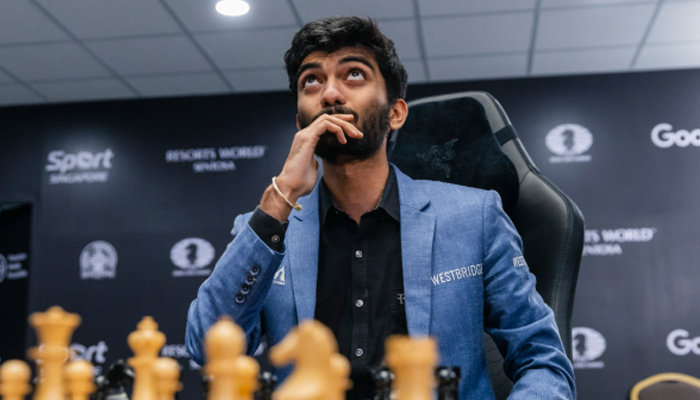
Gukesh’s Long Year: From World Champion to a Man Searching for Form.
Twenty-two thousand kilometres — that’s the distance D. Gukesh covered to reach Goa for the Chess World Cup. From Rhodes in Greece, where he won double gold at the European Club Championships, to St. Louis for the Clutch Championships against Magnus Carlsen, Hikaru Nakamura, and Fabiano Caruana, and finally across the Atlantic to India — his 2025 calendar has been as relentless as it has been revealing.
Despite flashes of brilliance, Gukesh finished last in St. Louis, failing to register a single win against Carlsen. His arrival in Goa marked not just another tournament, but another test in a year that has consistently demanded answers from the reigning World Champion.
Why Play at All?
As the titleholder, Gukesh had no obligation to play in the Chess World Cup. The event’s top three finishers qualify for the 2026 Candidates — the very tournament whose winner will challenge him for the crown. Yet, he chose to play.
That decision speaks volumes about his philosophy. Unlike his predecessor Ding Liren, who retreated from competition after winning the title, Gukesh has sought constant battle — to stay sharp, to learn, to prove. But that hunger, admirable as it is, may also have been his undoing. The repeated travels, the non-stop grind, and the pressure to validate his reign have combined to produce what has been a deeply testing year.
The Horror of 2025
After scaling the peak in 2024 — winning the Candidates, lifting double gold at the Olympiad in Budapest, and bringing the world title back to India after 11 years — Gukesh entered 2025 as the sport’s golden boy. But chess has a way of turning fairy tales into gauntlets.
The year began brightly at Tata Steel in Wijk aan Zee, where he led for much of the event and seemed poised to begin his reign with a statement win. Then came the final day. A loss to Arjun Erigaisi pushed him into tiebreaks — a format that has long exposed his weaknesses. Praggnanandhaa capitalised, winning the title and stealing the headlines.
That defeat hurt. For the first time since becoming champion, Gukesh looked rattled — chasing perfection rather than playing naturally. The Freestyle events that followed, in Weissenhaus and Paris, only amplified that discomfort. His struggles in the new hybrid formats prompted murmurs online: was he truly world champion material? Carlsen’s thinly veiled remarks about the “legitimacy” of recent champions — a reference to those who won during his absence — didn’t help.
One Bright Spark
If there was one redeeming chapter in his turbulent year, it came at Norway Chess 2025. Finishing third may not sound spectacular, but two of his victories — over Hikaru Nakamura and, crucially, over Magnus Carlsen in Stavanger — carried immense symbolic weight.
Carlsen’s visible frustration after that loss evoked memories of 2013, when he had dethroned Viswanathan Anand in Chennai. Now, the tables had turned. For a moment, Gukesh had not only beaten the game’s greatest figure but silenced his doubters.
Yet even that high came with a tinge of disappointment — he still couldn’t win the event. A recurring theme of 2025: near-misses, not milestones.
The Decline Continues
After Norway, the slide resumed. Gukesh finished a dismal 41st in the Grand Swiss, and in Goa, his Chess World Cup campaign ended in the third round against Frederik Svane. The loss was especially painful. In a critical moment, Gukesh ignored a simple threefold repetition that would have secured a draw and forced tiebreaks. Instead, driven by ambition, he overreached — and lost.
It was a fitting metaphor for his season. The fine line between confidence and recklessness has blurred, and his sense of balance — so crucial in elite chess — seems to have deserted him.
The Road to 2026
As 2025 draws to a close, Gukesh stands at a crossroads. Out of the eighteen world champions in history, only ten have managed to defend their title. In the modern era, only Anand and Carlsen have done it. The physical, psychological, and emotional demands of that defence are immense.
For Gukesh, 2025 has been a year of humility — a reminder that greatness in chess is as much about resilience as brilliance. If he can regroup and rise again in 2026, it will rank among the greatest achievements in Indian sport. But for now, the reigning champion is learning the hardest lesson of all: that staying on the summit is far tougher than getting there.
Comments are closed.