
Healing Lives, Chasing Gold: Marathoner-Doctor Kartik Karkera Sets Asian Games Sights

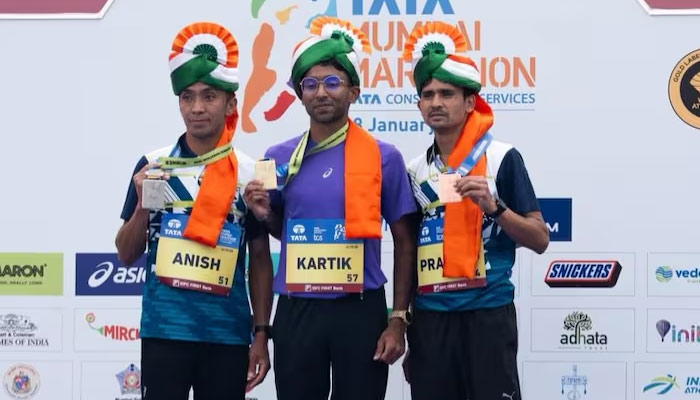
At 15, a question was thrown at Kartik Karkera that most middle-class Indian children know too well: studies or sport?
Growing up in Mumbai, Kartik understood the answer wasn’t really a choice. It was expectation.
He chose studies.
The medals he had won in school competitions were put aside as he focused on academics, eventually leaving for Russia in 2016 to pursue MBBS. It was the safe path, the certain one.
But running never truly left him.
For eight years in Russia, Kartik built a career in medicine, completing his MBBS and a post-graduation in orthopaedics and traumatology. In January 2024, he cleared the Foreign Medical Graduate Examination, opening the door to practise in India.
That’s when the same question returned — but this time, without a predetermined answer.
Doctor or runner?
Now, he chose both.
THE DOUBLE LIFE
Back in India, while working as a resident doctor at a hospital in Nashik, Kartik quietly began chasing the dream he had once shelved.
It wasn’t easy.
Hospital shifts stretched endlessly. Training had to be squeezed into whatever time remained. Sleep became optional.
Yet, results came quickly.
In just his third competitive marathon, the 28-year-old stunned the field to win the Delhi Marathon in April, beating seasoned names like T Gopi and Man Singh. His timing of 2:13:10 not only marked a personal best but also comfortably breached the Athletics Federation of India’s Asian Games qualification mark.
Almost overnight, Kartik went from being an unknown name to one of India’s fastest marathon runners.
He smiles at that label.
“People call me an overnight success,” he says. “They don’t see the 10 years of work behind it.”
RUNNING ON EMPTY
Balancing medicine and elite sport is rare. Sustaining both is even rarer.
Kartik did it through sheer stubbornness.
There were days when he ran before entering a 36-hour hospital shift — not because it was easy, but because skipping it felt worse.
“There are OTs, patients… you can’t say no,” he says. “But I still needed to train.”
He ran at 4 am. He ran at 11 pm. He ran whenever time allowed.
What kept him going wasn’t ambition alone.
Running gave him something medicine couldn’t — stillness.
“It’s almost meditative,” he says. “It cuts through everything else.”
THE RUSSIA TURNING POINT
Ironically, it was in Russia — where he had gone to bury his sporting ambitions — that the dream was reborn.
What began as 30 minutes of daily exercise during his second year gradually turned into something more serious.
Then came Covid-19.
With classes disrupted and time suddenly abundant, Kartik found himself training relentlessly on a quiet 400m track near his university.
Alone, without competition or crowd, he ran.
20 kilometres. 25 kilometres. Day after day.
“That year changed everything,” he says. “That’s when I realised — I can be very good at this.”
The shift was complete.
He was no longer a doctor who liked running.
He was a runner who happened to be a doctor.
LEARNING FROM THE BEST
His performances in Russia began to attract attention.
He became a university champion and caught the eye of a Moscow-based sponsor, Denis Nikiforov, who connected him with Olympic champion Yuriy Borzakovskiy.
Under Borzakovskiy, Kartik learnt the science of elite training — discipline, recovery, and pushing limits.
His medical background became an advantage.
Having studied orthopaedics and worked with athlete rehabilitation, he understood his body better than most.
“Knowledge is power,” he says. “I’ve applied everything I’ve learnt to myself.”
RETURN, RESET, RISE
When Kartik returned to India, he was back to square one.
No recognition. No guarantees.
But the results followed.
He won the Tata Mumbai Marathon earlier this year and then the Delhi Marathon, announcing himself as a serious contender on the national stage.
His current best time puts him right in the mix for an Asian Games medal — a prize India hasn’t claimed in the marathon since 1951.
WAITING FOR THE CALL
For now, Kartik continues his routine in Nashik.
Morning runs fuelled by coffee, bananas, and beetroot juice. Afternoons spent consulting patients. Evenings back on the road.
Much of what he earns goes back into sustaining his training.
The official Asian Games selection is still awaited. There’s uncertainty.
But that no longer bothers him.
Because the real battle was never just about selection.
It was about proving something deeper.
At 15, he was told to choose between stability and passion.
More than a decade later, Kartik Karkera is proving that the choice itself was flawed.
He didn’t have to give one up to pursue the other.
He could be both.
Comments are closed.