

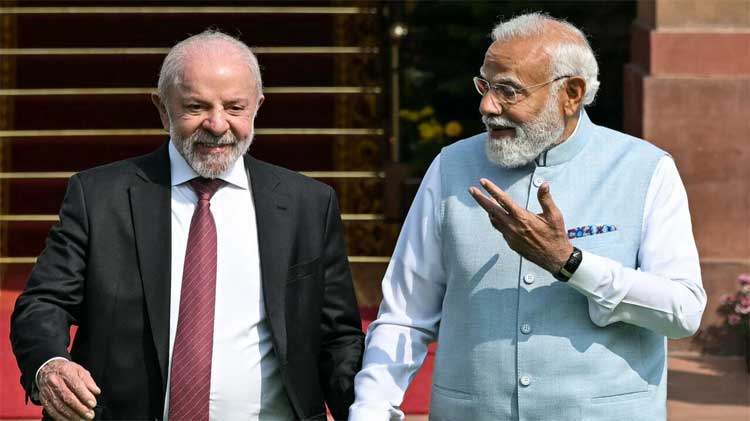
India and Brazil on Saturday agreed to double bilateral trade to $30 billion by 2030 and signed key agreements on cooperation in critical minerals and the steel supply chain, as Prime Minister Narendra Modi and President Luiz Inacio Lula da Silva held talks centred on strengthening economic ties and advancing multilateralism amid global uncertainty.
Lula, visiting India with a delegation that included around 300 business representatives, met Modi after attending the AI Impact Summit. The visit comes months after Brazil signalled plans to deepen engagement with India to cushion the effects of shifting global trade dynamics, including tariff pressures under the Trump administration. Both countries had faced steep US tariff measures in recent years.
The leaders pledged to expand collaboration across defence, security, energy, healthcare, and digital public infrastructure, underscoring the need for closer strategic coordination in a fragmented global environment.
“Brazil is India’s largest trading partner in Latin America. We are committed to taking bilateral trade beyond $20 billion in the next five years. Our trade is not just a figure, it’s a reflection of trust,” Modi said during a joint media interaction.
Two-way trade crossed $15 billion for the first time in 2025, reflecting a 25% increase over 2024. While the two sides had earlier set a $20 billion trade target for 2030, they now aim higher. P Kumaran, secretary (East) in the external affairs ministry, said both leaders agreed trade should “at least double to $30 billion by 2030.”
The discussions also touched on US trade policy and the implications of the US Supreme Court’s ruling on President Donald Trump’s tariffs. Kumaran described the judgment as a “new development,” saying both sides would study its potential effects.
Highlighting India’s strengths in IT, AI, biotechnology, and space, Lula pointed to fresh opportunities for cooperation. He emphasised that investments in renewable energy and critical minerals form the core of newly signed agreements.
Modi described the pact on rare earths as a “major step” toward building resilient supply chains, noting that defence cooperation between the two nations continues to deepen.
India is actively seeking to diversify sources of rare earths and critical minerals to reduce reliance on China and support industrial expansion. Brazil, one of the world’s leading iron ore producers with vast mineral reserves, is seen as a natural partner, particularly for India’s fast-growing steel sector.
The leaders reviewed progress on expanding the India-Mercosur Preferential Trade Agreement (PTA). Lula said India’s recently concluded trade deal with the European Union should encourage broader efforts to strengthen India-Mercosur economic integration.
Healthcare and pharmaceuticals emerged as another priority area. Modi said India would work to boost supplies of affordable medicines to Brazil, while Lula highlighted decades of joint advocacy for equitable access to generic drugs at global forums.
In defence and aeronautics, both sides discussed cooperation on maintaining Scorpene-class submarines under a tripartite framework involving Mazagon Dock Shipbuilders Limited and the Indian and Brazilian navies. Modi also urged Brazilian aircraft manufacturer Embraer to establish a maintenance, repair, and overhaul (MRO) facility in India alongside its planned E175 assembly line.
The talks reaffirmed shared positions on global governance and multilateralism. Modi said India and Brazil would continue championing the priorities of the Global South, while Lula described the partnership as one between a “digital superpower” and a “renewable energy superpower.”
On security issues, Modi stressed that terrorism and its supporters are “enemies of all humanity.” Lula condemned terrorism and reiterated Brazil’s support for peace efforts, including ending the war in Ukraine and addressing humanitarian concerns in Palestine.
The visit resulted in multiple agreements, including MoUs on rare earths and critical minerals, mining cooperation for the steel supply chain, a joint action plan on digital partnership, cooperation in the coastal sector and MSMEs, and regulatory collaboration between Brazil’s health authority and India’s Central Drugs Standard Control Organisation.
Comments are closed.