

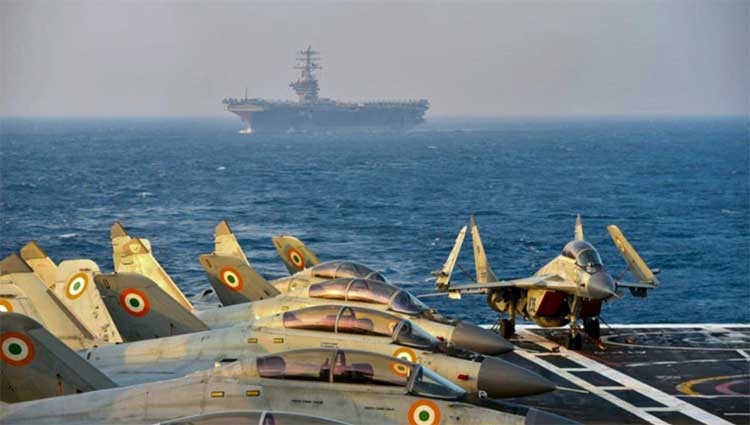
India and several Indian Ocean neighbours on Saturday backed regional cooperation frameworks to safeguard maritime security and uphold international law, days after a United States submarine sank the Iranian warship IRIS Dena near the coast of Sri Lanka.
Speaking at the Raisina Dialogue, external affairs minister S. Jaishankar said India continues to act as a “net security provider” in the Indian Ocean region.
Jaishankar joined his counterparts from Sri Lanka, Mauritius and Seychelles in stressing the need to respect international law, particularly the United Nations Convention on the Law of the Sea (UNCLOS), to address recent developments and ensure freedom of navigation and uninterrupted global trade.
The discussion comes after the sinking of IRIS Dena on March 4 near Sri Lanka, which has raised concerns about the spillover of the West Asian conflict into India’s strategic neighbourhood. The warship had been leaving the region after participating in an international fleet review and a multinational naval exercise hosted by India.
Since then, two more Iranian warships have docked in ports in Sri Lanka and India, with their crews accommodated onshore.
Jaishankar — the first senior Indian leader to publicly comment on the incident — said Iran had informed India on February 28 that one of its ships needed to enter an Indian port after encountering difficulties. India granted permission on March 1, and the warship IRIS Lavan docked at Kochi on March 4. Its crew, including several young naval cadets, are currently staying at a nearby facility.
“These ships… when they set out and came here, the situation was totally different. They were coming for a fleet review and then they got caught on the wrong side of events,” Jaishankar said.
“For us, when this ship wanted to come in and that too in difficulties, it was the humane thing to do. We were guided by that principle. Of the other ships, one had a similar situation in Sri Lanka and they took the decision which they did. And one unfortunately didn’t make it,” he added, referring to the sinking of IRIS Dena.
In a carefully calibrated response, Jaishankar reiterated that India remains a “net security provider” in the Indian Ocean, even as major powers such as the United States and China maintain a military presence in the region.
He pointed to long-standing foreign bases including Diego Garcia, the presence of international forces in Djibouti, and the headquarters of the United States Fifth Fleet in Bahrain. He also referenced the development of Hambantota Port in Sri Lanka.
Vijitha Herath, foreign minister of Sri Lanka, said Colombo was handling the situation strictly in line with international law, including UNCLOS.
“Sri Lanka faces many challenges… We need to strengthen the implementation of international laws,” he said, adding that the country had acted in a humanitarian manner without taking sides in the conflict.
Foreign ministers Dhananjay Ramful of Mauritius and Barry Faure of Seychelles also underlined the need for stronger regional cooperation to maintain maritime security and uphold international law in the Indian Ocean.
Jaishankar further highlighted India’s focus on protecting Indian seafarers and the roughly 10 million Indian nationals living in West Asia amid ongoing conflicts.
“Indians are a very large segment of the people who man merchant ships. Every time there is an attack on a tanker or vessel carrying goods, it is very likely that all or part of that vessel is manned by Indians,” he said, noting that Indian sailors had been among the casualties in recent attacks on two oil tankers.
Comments are closed.