

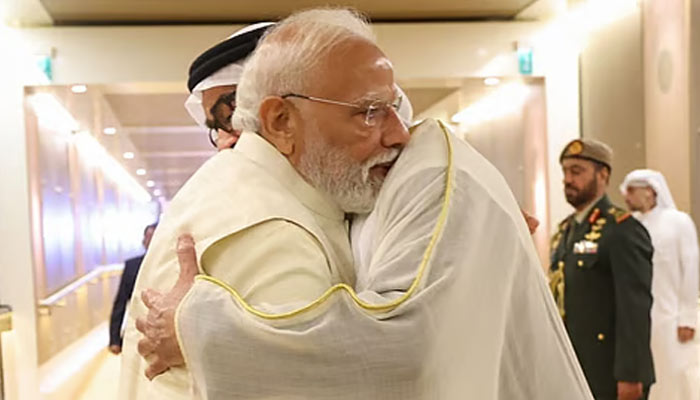
India and the United Arab Emirates have agreed to significantly expand their energy partnership.
With the UAE set to store up to 30 million barrels of crude oil in India’s Strategic Petroleum Reserve system, the Ministry of External Affairs (MEA) said on Friday following Prime Minister Narendra Modi’s visit to Abu Dhabi.
The agreement was finalised during talks between Prime Minister Modi and UAE President Sheikh Mohamed bin Zayed Al Nahyan. Both leaders also emphasised the need to ensure safe and uninterrupted navigation through the Strait of Hormuz, amid heightened tensions in West Asia.
In a statement, the MEA said both sides “welcomed the conclusion of a Strategic Collaboration Agreement between Indian Strategic Petroleum Reserves Limited and Abu Dhabi National Oil Company to enhance UAE’s participation in India’s Strategic Petroleum Reserves to 30 million barrels.”
The move is expected to strengthen India’s energy security by providing greater resilience against global crude supply disruptions.
Alongside crude storage cooperation, the two countries also agreed to explore the development of strategic gas reserves in India. They also welcomed a separate arrangement between Indian Oil Corporation and ADNOC for long-term LPG supply.
The MEA described the UAE as a key partner in India’s energy security architecture, adding that both sides would pursue “new initiatives for a comprehensive energy partnership” covering crude oil, LNG, and LPG.
Beyond energy, the visit also saw commitments of around USD 5 billion in UAE investments in India across banking, infrastructure, and financial services. Several new agreements were also announced in defence cooperation, maritime security, shipbuilding, and advanced computing.
Prime Minister Modi’s visit came amid rising geopolitical tensions in the region and volatility in global energy markets. The MEA said the leaders discussed regional stability and security, with India reaffirming its condemnation of recent attacks on the UAE and expressing solidarity with its leadership and people.
With concerns over potential disruptions to key shipping routes such as the Strait of Hormuz, both sides stressed the importance of protecting trade corridors and strengthening long-term energy and economic cooperation.
Comments are closed.