

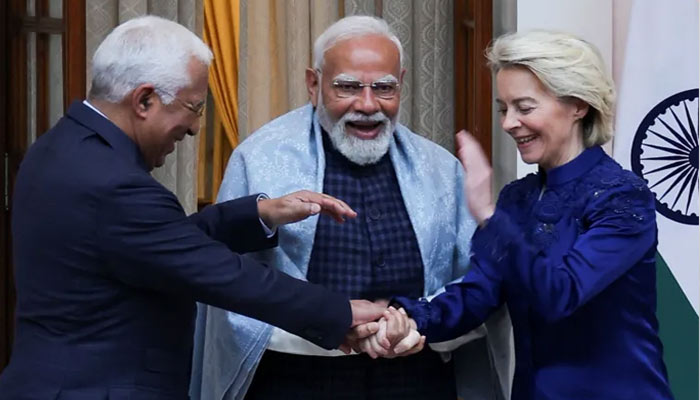
It Ain’t Over Till It’s Over: How India Turned the Trade Game in Weeks
India, a cricket-worshipping nation, knows well the value of persistence: the game isn’t over until the last ball is bowled. Over the first weeks of January, a similar lesson played out on the diplomatic field. After being seen as lagging in the US trade deal, India suddenly scored a string of victories with new trade agreements that reshaped the international picture.
On Tuesday, India and the European Union (EU) announced the conclusion of negotiations on a free trade agreement (FTA), following India’s recent deals with New Zealand, the UK, and Oman. The EU-India FTA, dubbed the “Mother of All Deals,” is the largest ever between the two sides, covering 25% of global GDP and one-third of international trade.
The optimism stands in stark contrast to the earlier mood. Last month, Howard Lutnick, US Commerce Secretary under Trump, criticized India for missing an opportunity with the US, claiming that a simple call from Prime Minister Narendra Modi could have closed the deal. Opposition parties also seized the moment to mock the government.
Some analysts argue that former US President Donald Trump’s tariff threats and unilateral moves may have inadvertently nudged the EU-India deal forward. The Economist noted that “without his adventurism and habit of alienating allies, the two big democracies might not have found the courage to strike a deal.” India’s Commerce Minister Piyush Goyal, however, dismissed Trump’s role, saying the EU-India FTA wasn’t prompted by US pressure.
The timing, nonetheless, could hardly be better. EU Commission President Ursula von der Leyen said in New Delhi: “We have concluded the mother of all deals. We have created a free trade zone of two billion people, with both sides set to benefit. This is only the beginning.”
India’s major trade deals in 2025 and 2026 (As of January 2026).
| Trade Deal Partner | Signing Date | Negotiation Start Date | Time Taken to Finalise |
| UK | July 24, 2025 | January 2022 | 3.5 years |
| Oman | December 18, 2025 | November 2023 | 2 years and 1 month |
| New Zealand | December 22, 2025 | March 2025 (stalled in 2015, relaunched in 2025) | 9 months (post-relaunch) |
| European Union | January 27, 2026 | 2007 (relaunched 2022; accelerated 2025) | 3 years (post-relaunch) |
| US | No deal signed yet | February 2025 | Process underway |
India has approached trade negotiations strategically, balancing speed with careful safeguards for domestic sectors like agriculture and dairy. The India-New Zealand FTA, finalized in record time after talks resumed in March 2025, contrasts with the still-pending US negotiations. Similarly, India’s deal with the UK, inked in July 2025, provides duty-free access for 99% of Indian exports while easing tariffs on British goods like Scotch whisky and automobiles.
The India-EFTA Trade and Economic Partnership Agreement (TEPA), effective October 2025, commits Switzerland, Norway, Iceland, and Liechtenstein to $100 billion in investments over 15 years, aiming to generate one million direct jobs. India also signed a comprehensive trade deal with Oman in December, granting zero-duty access to 98% of Indian exports.
Looking ahead, Canadian Prime Minister Mark Carney is expected to visit India in March to sign key deals on uranium, energy, minerals, AI, and education—part of Canada’s strategy to diversify trade after clashes with the Trump administration.
The flurry of agreements, especially the EU-India FTA allowing preferential access for over 99% of Indian exports, has strengthened India’s negotiating position globally. US Treasury Secretary Scott Bessent noted the impact: “We have put 25% tariffs on India for buying Russian oil. Guess what happened last week? The Europeans signed a trade deal with India.”
Market analysts and diplomats alike see India gaining strategic leverage. “India doesn’t have to rely solely on China or the US. It just inked a deal impacting two billion people,” said Derek J. Grossman, national security and Indo-Pacific analyst.
Much like a cricket match, where a single good over can turn the game, India’s diplomatic innings has shown that momentum can shift quickly. Just weeks ago, criticism dominated headlines; now, the trade winds are firmly blowing in New Delhi’s favor.
Comments are closed.