

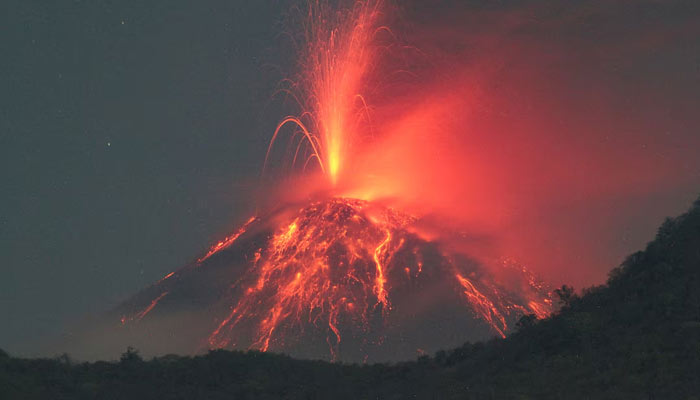
Indonesia’s Mount Lewotobi Laki Laki Unleashes Massive Eruption for Second Day.
Indonesia’s Mount Lewotobi Laki Laki erupted for the second day in a row on Saturday, spewing a massive ash column as high as 18 kilometers into the sky and covering nearby villages in volcanic debris. Authorities reported no immediate casualties.
The Saturday morning eruption followed a dramatic blast on Friday night, which had shot ash clouds up to 10 kilometers high, illuminated the sky with molten lava, and triggered volcanic lightning. Both eruptions occurred within five hours of each other, indicating heightened volcanic activity.
The country’s Geology Agency confirmed that searing pyroclastic flows—superheated gas, ash, and rock—traveled as far as 5 kilometers down the slopes. Drone footage showed deep magma movement inside the volcano, accompanied by tremors recorded on seismic monitors.
Volcanic material, including thumb-sized hot gravel, was thrown up to 8 kilometers from the crater. Surrounding towns were coated in thick ash, and authorities warned residents to stay alert as heavy rain could trigger dangerous lava flows in riverbeds.
Saturday’s eruption was one of the most powerful Indonesia has seen since the deadly 2010 eruption of Mount Merapi, which killed over 350 people on Java island and displaced hundreds of thousands.
Just weeks earlier, a July 7 eruption had disrupted air travel across Bali, leading to widespread flight delays and cancellations, and covering farmland in thick mud and rock.
Located on the island of Flores, the 1,584-meter-tall Lewotobi Laki Laki volcano has remained at the highest alert level since June 18. The government expanded the exclusion zone to 7 kilometers and has permanently relocated thousands following deadly eruptions in November that killed nine and destroyed thousands of homes.
Indonesia, an archipelago of over 280 million people, sits along the Pacific “Ring of Fire,” one of the most seismically active zones in the world. With 120 active volcanoes, the country is highly vulnerable to frequent eruptions and earthquakes.
Comments are closed.