
Iran Signals Readiness for War with Israel, Vows to Continue Nuclear Programme: President Pezeshkian

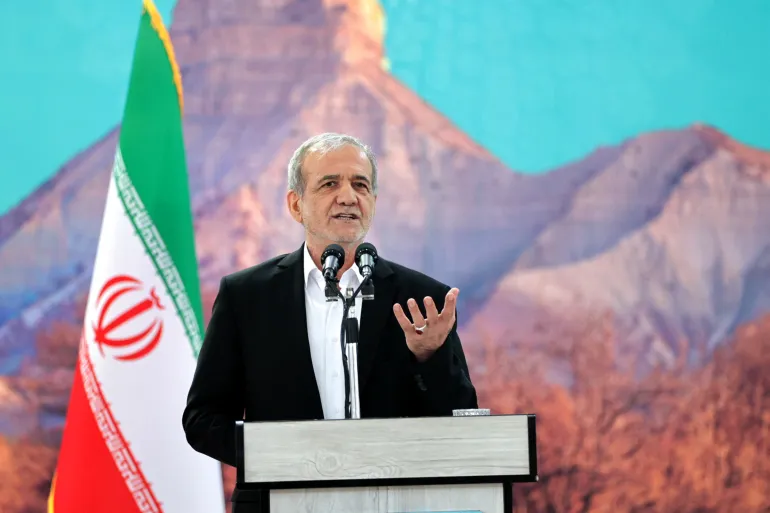
In a bold and confrontational stance, Iranian President Masoud Pezeshkian declared that Iran is prepared for war with Israel and will not be deterred from continuing its nuclear programme. The statement marks a sharp escalation in the already volatile Iran-Israel dynamic, drawing global attention amid rising tensions in the Middle East.
Speaking during a nationally televised address on Wednesday, Pezeshkian emphasized that Iran’s military is fully prepared to respond to what he described as “any aggression from the Zionist regime.” He asserted that Iran’s nuclear ambitions are non-negotiable and will move forward irrespective of international pressure or the threat of military conflict.
“We will never bow to threats or sanctions. Our nuclear programme is peaceful, but we will not halt it under coercion,” Pezeshkian stated. “Iran is ready to defend its sovereignty and its people. If Israel dares to act against us, it will face a response it cannot imagine.”
Pezeshkian’s comments come amid growing concerns in Tel Aviv and Washington about the progress of Iran’s nuclear enrichment activities. According to recent reports from the International Atomic Energy Agency (IAEA), Iran has significantly increased its stockpile of enriched uranium, sparking fears that it may be approaching weapons-grade levels. Western intelligence agencies have also flagged renewed activity at key Iranian nuclear facilities.
Israel has long regarded Iran’s nuclear ambitions as an existential threat and has previously signaled a willingness to launch preemptive strikes to prevent Iran from obtaining nuclear weapons. In response, Iran has bolstered its defense systems and deepened its ties with regional proxies such as Hezbollah in Lebanon and various armed factions in Syria and Iraq.
In the wake of Pezeshkian’s remarks, Israeli officials held emergency security consultations. Defense Minister Yoav Gallant reiterated that Israel “will not allow Iran to acquire nuclear weapons” and warned that any threat to Israeli sovereignty would be met with decisive action.
Global reactions have been swift. The United Nations urged both countries to exercise restraint and return to diplomatic dialogue. The European Union called the statements “deeply troubling,” while the United States reaffirmed its commitment to Israel’s security, without commenting directly on Pezeshkian’s speech.
Experts note that Pezeshkian’s rhetoric signals a significant shift in tone from previous Iranian administrations, indicating a more aggressive posture on both military and nuclear fronts. His administration appears to be consolidating a hardline position, possibly to gain leverage in any future diplomatic negotiations or to strengthen domestic political support.
The rising tensions have further destabilized the region, which is already grappling with the ongoing Gaza conflict, Houthi attacks in the Red Sea, and instability in Syria and Iraq. The prospect of a direct Iran-Israel confrontation could have far-reaching consequences, including disruption of global oil supplies, regional military escalation, and increased pressure on global diplomatic channels.
As international observers monitor developments closely, the coming days will be critical in determining whether the rhetoric turns into action or whether backchannel diplomacy can prevent a larger military conflict.
Comments are closed.