
Italy’s Ventina Glacier Shrinks Beyond Monitoring as Climate Crisis Accelerates, Say Geologists

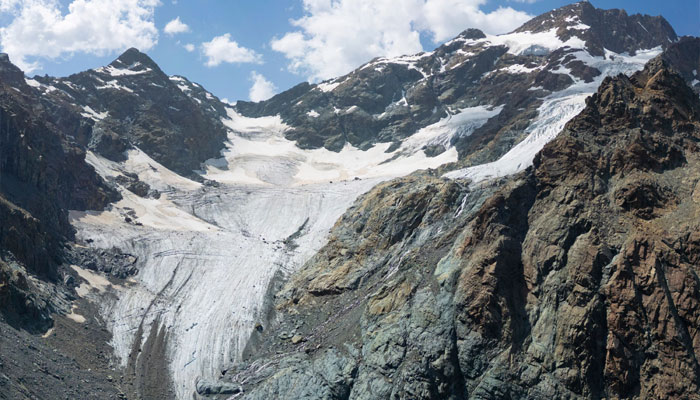
Italy’s Ventina Glacier Melts Beyond Traditional Monitoring as Climate Crisis Accelerates.
Italy’s Ventina glacier, one of the largest in northern Lombardy, has shrunk so dramatically due to climate change that geologists can no longer measure it using the methods they have relied on for the past 130 years.
Following this year’s scorching summer, researchers found that the traditional stakes used to track the glacier’s retreat are now buried under rockslides and debris, leaving the terrain too unstable for in-person visits.
The Lombardy Glaciological Service announced Monday that it will now rely on drone imagery and remote sensing to monitor the glacier, located near Sondrio—an area that will host events during the 2026 Winter Olympics.
Since the first benchmarks were placed at the glacier’s front in 1895, Ventina has already lost 1.7 kilometers (1 mile) in length. The retreat has accelerated in recent years, with 431 meters (471 yards) lost over the last decade—nearly half of that since 2021, highlighting the impact of rising temperatures on Europe’s glaciers.
“While we could still hope until the 1980s that the glacier would follow normal cycles or at least a contained retraction, in the last 40 years something truly striking has occurred,” said Andrea Toffaletti of the Lombardy Glaciological Service.
Italy’s mountain glaciers, found across the Alps, Dolomites, and central Apennines, have been receding steadily due to insufficient winter snowfall and increasingly hot summers. Normally, summer melting contributes to rivers and streams, but recent heatwaves are eroding the winter snowpack needed to sustain the glaciers.
“To remain balanced, a glacier must retain a residual layer of snow at the end of summer, but this is happening less frequently,” Toffaletti explained. The Alps are a climate hotspot, warming at roughly twice the global average since pre-industrial times. This has resulted in the loss of over 64% of the volume of Alpine glaciers.
A February study published in Nature highlighted the global scale of glacier loss: the world’s glaciers shed roughly 255 billion tons (231 billion metric tons) of ice annually between 2000 and 2011, a figure that increased to about 346 billion tons (314 billion metric tons) per year in the following decade.
Ventina’s dramatic retreat serves as yet another stark indicator of the accelerating impact of global warming on Europe’s glaciers, with broad environmental implications for water resources, ecosystems, and local communities.
Comments are closed.