

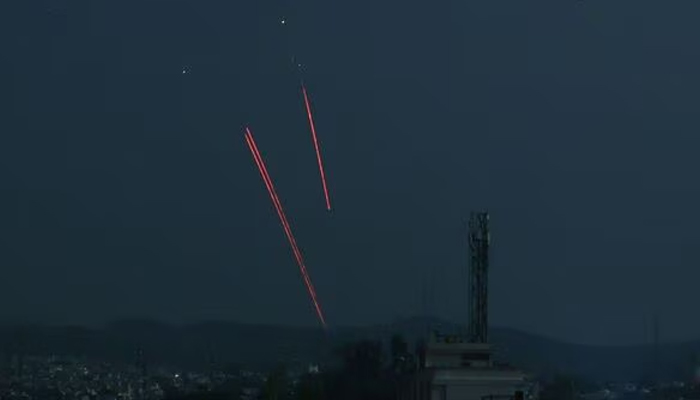
In a dramatic escalation late last night, Pakistan violated a ceasefire agreement with India just hours.
After the two sides had agreed to pause hostilities following days of unprovoked Pakistani aggression. Explosions were reported in Jammu and Kashmir’s Baramulla and along the Line of Control (LoC), where drones were spotted in the skies shortly after the truce came into effect.
The fragile ceasefire collapsed almost immediately, as artillery shelling by Pakistani forces was reported from the Akhnoor, Rajouri, and RS Pura sectors near the International Border. According to officials, Indian air defence systems were swiftly activated after multiple drone sightings in the Rajouri sector and Srinagar, where at least four drones were downed near an Army headquarters.
A blackout and red alert were imposed in several areas of Srinagar amid fears of further drone strikes. Simultaneously, explosions were heard in Rajasthan’s Pokhran region, where Indian forces intercepted and shot down additional aerial threats.
India snatched defeat from jaws of victory: Brahma Chellaney on ceasefire with Pak
Before ceasefire came India’s Israel-like shift in policy towards Pakistan
Crossed all acceptable limits: Congress issues show cause notice to Laxman Singh
The Border Security Force (BSF) was directed to retaliate with full force against continued provocations, as India maintained a high state of operational readiness. Government sources confirmed that the ceasefire breach has once again exposed Islamabad’s duplicity, coming after days of civilian and military targets being struck by Pakistani drones and long-range weapons.
India’s Foreign Secretary Vikram Misri, during a press briefing on Saturday, announced that the ceasefire came after Pakistan’s Director General of Military Operations (DGMO) called India. “The Director General of Military Operations of Pakistan called the Director General of Military Operations of India at 3:35 pm earlier this afternoon,” Misri stated.
He further announced that another set of talks would take place at noon on May 12. US President Donald Trump said he, along with Vice President JD Vance, held “long talks” with New Delhi and Islamabad, following which the two parties agreed to end military action. India, however, said Pakistan’s DGMO initiated the call after which discussions took place and an understanding was reached.
Pakistan, however, reversed the script and broke the ceasefire deal within hours after drones were spotted in several areas, including parts of Kashmir, Jammu, and the forward lines of Punjab. Explosions were also heard and blackouts imposed in several areas as a precaution.
Four explosions were heard in Rajasthan’s bordering district of Jaisalmer after Pakistan violated the ceasefire and resorted to unprovoked shelling near the Line of Control and the International Border.
National Security Advisor Ajit Doval spoke to Chinese Foreign Minister Wang Yi amid the ceasefire violation by Pakistan. Doval stated that the Pahalgam terrorist attack had caused significant casualties among Indian personnel, and that India needed to take counter-terrorism actions. He emphasised that war is not India’s choice.
The Chinese Minister said that he hoped that both sides would remain calm and exercise restraint, resolve differences through dialogue and consultation, and avoid further escalation. Despite the ceasefire violation, the situation in the border states remained more or less peaceful through the night with no reports of cross-border firing, enemy engagement, or hostile movement along the International Border (IB) or Line of Control (LoC).
A heightened state of alert continues across the state and border districts. A red alert is still in effect in Amritsar as a precautionary measure to ensure public safety. Strong border patrols are in place. No suspicious movement or hostile activity was reported along the IB or in the airspace overnight. Security forces remain on alert.
State and district authorities, along with the Home Ministry, conducted a review meeting. Conditions remained normal across the Rann region, coastal areas, and airspace.