

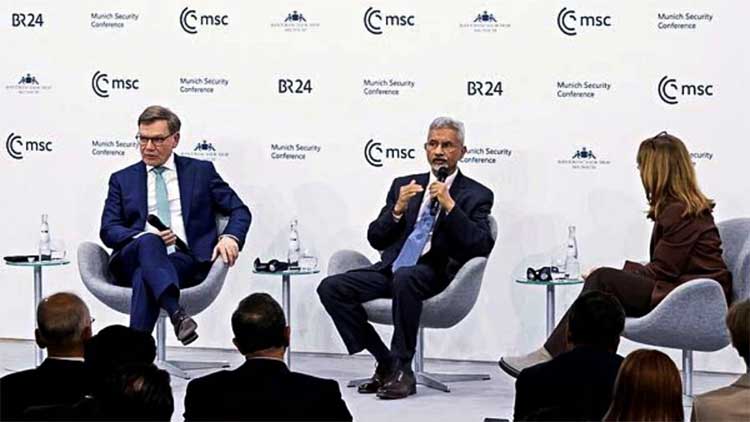
External Affairs Minister S. Jaishankar on Saturday reiterated that India remains firmly committed to its policy of strategic autonomy, stressing that decisions on energy imports are guided by market realities rather than geopolitical pressure.
Speaking at the Munich Security Conference during a discussion with German Foreign Minister Johann Wadephul, Jaishankar said countries worldwide are recalibrating their policies amid significant global shifts and seeking new areas of cooperation.
Addressing questions on whether India’s energy ties with Russia could affect its strategic autonomy, Jaishankar said the principle remains deeply embedded in India’s political and historical framework.
“We are very much wedded to strategic autonomy because it’s very much a part of our history and our evolution,” he said.
On energy procurement, Jaishankar highlighted the complexity of global oil markets, noting that purchasing decisions are driven by commercial considerations.
“Oil companies in India — as in Europe and other parts of the world — look at availability, cost and risks and take decisions that they feel are in their best interests,” he said.
The remarks come amid repeated assertions by the Trump administration that New Delhi committed to reducing Russian oil imports as part of a trade arrangement with the United States. India has not formally confirmed or denied those claims.
Jaishankar underscored that India retains the freedom to make independent policy choices, even when they diverge from Western partners.
“If the bottom line of your question is — would I remain independent-minded and make my decisions and make choices which may not agree with your thinking — yes, it can happen,” he said.
He also pointed to ongoing transformations in Washington’s global approach, describing them as reflecting both change and continuity.
The minister further emphasised the need for reform of the United Nations, citing recent global disruptions including the Covid-19 pandemic, the Ukraine conflict, Middle East tensions, and the rise of China.
As the world moves toward greater multipolarity, Jaishankar stressed the importance of strengthening India’s engagement with Europe, highlighting initiatives such as the India–European Union free trade agreement and the India–US trade deal.
Wadephul, for his part, said Europe is seeking reliable global partners amid growing uncertainty, describing India as one of Germany’s most significant partners. He noted expanding cooperation in trade, defence, climate resilience, and support for international rules-based norms.
Jaishankar also participated in multiple engagements on the sidelines of the conference, including discussions with G7 foreign ministers, where he reiterated India’s support for reform of the UN Security Council and emphasised priorities such as safeguarding sea lines of communication, port security, and resilient submarine cable infrastructure.
Comments are closed.