
Kashmir’s Lifeline at Risk: Climate Change Dries Fields, Shrinks Rivers

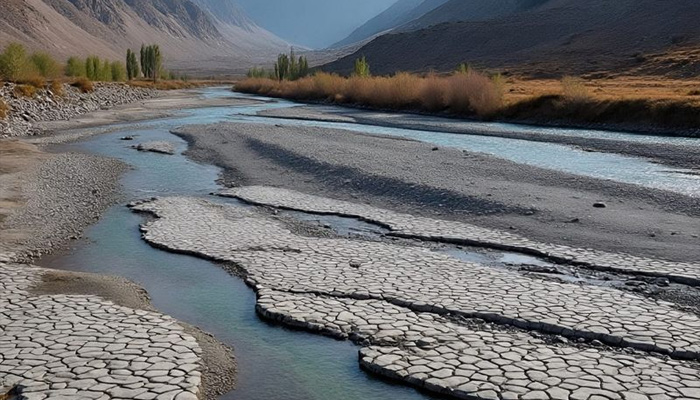
For centuries, Kashmir’s economy and culture have been shaped by its snow-fed rivers, fertile fields and orchards heavy with apples, cherries and walnuts.
Today, that lifeline is under mounting stress. Climate change is steadily eroding the region’s agricultural base and water resources, placing rural livelihoods at risk. Agriculture employs over 70 per cent of Kashmir’s population and contributes nearly 15 per cent to the local economy. Farmers across the Valley say those numbers now mask deep uncertainty. Shrinking glaciers, erratic rainfall and rising temperatures have turned farming into a high-risk occupation, marked by repeated crop losses, water shortages and mounting debt.
In Pulwama, apple grower Ghulam Nabi, who has tended orchards for more than three decades, says winters are shorter and increasingly unpredictable. “Trees bloom earlier than they used to, and then late frosts destroy the flowers,” he said. In many areas, apple yields have fallen by 40–50 per cent. With Kashmir accounting for more than three-quarters of India’s apple production, the decline has implications far beyond the Valley.
Saffron farmers in Pampore are facing an even steeper crisis. Once earning six to seven lakh rupees per acre, many now struggle to produce even half their earlier yields. Warmer winters and erratic rainfall have disrupted saffron’s fragile flowering cycle. Production, which exceeded eight metric tonnes in the early 2010s, has dropped to nearly one-third, with losses of 60–70 per cent reported by farming families.
Farming systems breaking down
Climate change is unraveling the finely balanced systems that support Kashmir’s agriculture. Rice cultivation across nearly 130,000 hectares depends on snowmelt and glacial rivers. Early melting and uneven rainfall have reduced water availability during crucial growth stages. In villages such as Haritar and Lelhar, irrigation canals that once ran steadily now fall dry for weeks.
To compensate, farmers are pumping groundwater from greater depths, sharply increasing costs. Others have been forced to leave land fallow. Vegetable growers report yield declines of up to 35 per cent in crops such as potatoes, tomatoes and cauliflower due to heat stress and insufficient irrigation.
The human toll
The consequences extend beyond crop statistics. Average temperatures in Kashmir have risen by about 0.6°C per decade over the past 30 years, disrupting traditional farming calendars. Heatwaves in May and June scorch wheat and mustard, while delayed monsoon rains leave rice fields cracked and dry.
Apple growers are also struggling with a sharp drop in chilling hours, which have fallen from around 1,500 two decades ago to below 1,000 today—well below what is needed for healthy fruiting. Many farmers have invested in sprinklers and cooling systems, often through loans they find hard to service. Smallholders with less than two acres of land are the most exposed, with some families slipping into chronic debt or considering migration.
Extreme weather events—late spring frosts, hailstorms during peak fruiting, and unseasonal downpours that strip away fertile topsoil—have become increasingly common. Farmers describe these disruptions as a “new normal” that has broken the Valley’s agricultural rhythm.
Water scarcity at the core
Water lies at the centre of Kashmir’s climate crisis. Glaciers such as Kolahoi, which feed major rivers, have retreated by nearly 900 metres over the past five decades, sharply reducing summer flows. Springs that once supplied villages year-round are drying up, with nearly one in four major springs showing significant decline.
In districts like Pulwama and Shopian, lift irrigation systems now operate at less than half capacity. Rising dependence on motor pumps has pushed irrigation costs up by 40–50 per cent, forcing many small farmers to scale back or abandon cultivation altogether.
The effects reach beyond agriculture. Reduced river flows have disrupted hydropower generation, affecting electricity supply in rural areas. Shrinking wetlands and groundwater recharge zones threaten long-term water security, while intense rainfall events increasingly lead to floods rather than replenishing aquifers.
A question of survival
Experts warn that Kashmir’s situation is also one of climate justice. The region contributes little to global greenhouse gas emissions but bears a disproportionate share of climate impacts. Farmers and agricultural labourers—once closely aligned with natural cycles—are now among the most vulnerable.
Addressing the crisis will require long-term adaptation rather than short-term relief. Specialists emphasise integrated watershed management, conservation of glaciers and springs, climate-resilient crop varieties, efficient irrigation and community-based early warning systems. Policies, they say, must prioritise smallholders and women farmers through access to training, credit and institutional support.
Kashmir’s experience is a warning for other glacier-fed mountain regions. Without timely intervention, climate stress could trigger food insecurity, economic shocks and migration far beyond the Valley.
As rivers shrink and fields dry, Kashmir’s agriculture stands at a crossroads. What is at stake is not just food production, but the social, cultural and economic fabric of a region whose life has always been tied to land and water. For farmers here, climate change is no longer an abstract threat—it is a daily struggle for survival.
Comments are closed.