
Late nights, long waits: Asian Games shuttlers face gruelling schedule in Japan

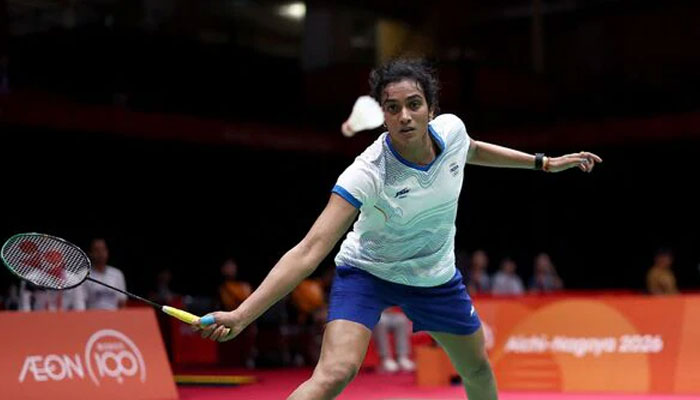
Midnight badminton, little recovery: Shuttlers struggle with Asian Games schedule in Japan
PV Sindhu began her third-round match against Japan’s Tomoka Miyazaki at 12:07 am on Sunday.
For most of the badminton contingent, the day was already over. For Sindhu and Miyazaki, it was not — it was their second match of the day.
Sindhu eventually won 21-9, 21-13, but the timing highlighted a growing concern at the Aichi-Nagoya Asian Games: the badminton schedule has left several players facing late-night finishes, early starts and unusually short recovery periods.
The team competition ran from September 20 to 24, followed immediately by the individual events from September 25. Badminton is scheduled to finish on September 29, even though the Asian Games continue until October 4.
That compressed calendar has forced some players to compete twice in a day, raising questions about recovery and player welfare in a sport where physical freshness can be decisive.
‘I feel it is cruel’: Prannoy
HS Prannoy, who was part of India’s bronze-medal-winning team before returning home, was among the first players to publicly raise concerns.
Speaking on a Badminton Association of India YouTube show, Prannoy recalled how late the Indian team returned to its hotel after the team-event medal ceremony.
“We finished the team event, the prize distribution took almost an hour, and it was 11:15 pm by the time we left the stadium. And it’s one hour from the stadium to our hotel,” he said.
With no proper meal available near the venue, players ate only after returning to the hotel, around 12:30 or 1 am. Prannoy pointed out that Dhruv Kapila and Tanisha Crasto then had matches scheduled at 9 am.
“What if it was against a top seed or probably a higher seed? It would have been very taxing,” he said.
“I think it’s so unfair on a lot of players. I feel it’s cruel. Everybody is aiming for a good Asian Games. It comes once every four years. Just because of your problem, it shouldn’t be happening like this.”
Prannoy also questioned why badminton could not be given more time, given that the Games continue until October 4.
“Having two singles matches in a day, I have not seen that in ages,” he said.
Sindhu’s midnight test
Saturday provided the clearest example of the problem.
Singles players were required to play twice, leaving them with little time to recover between matches.
Lakshya Sen lost to Singapore’s Loh Kean Yew in the men’s singles second round, while Ayush Shetty followed a win over Kazakhstan’s Makhsut Tajibullayev with a three-game defeat to Chou Tien Chen.
Sindhu’s second match began just after midnight.
The two-time Olympic medallist, however, negotiated the unusual timing without much trouble, beating Miyazaki in straight games.
Her next challenge was scheduled for around 1 pm the following day against world No. 4 Chen Yufei — giving her only around 13 hours between matches.
The quarter-final was also listed on Court 4, which did not have a broadcast feed.
Other players caught in the squeeze
The tight schedule has affected players from other countries too.
Thailand’s fifth-ranked mixed doubles pair Dechapol Puavaranukroh and Supissara Paewsampran played their opening-round match at 9 am after Dechapol had reportedly remained at the venue until around 11:30 pm the previous night for the team-event medal ceremony.
They lost to Japan’s Yuta Watanabe and Maya Taguchi.
Watanabe and Taguchi themselves had to return to court later that day and subsequently lost in the second round.
India’s Satwiksairaj Rankireddy and Chirag Shetty also acknowledged the difficulty of moving straight from the team event into individual competition.
The pair had played a key role in India’s team campaign, including a win over world champions Liang Wei Keng and Wang Chang of China, before suffering a first-round upset against Thailand’s Peeratchai Sukphun and Pakkapon Teeraratsakul.
“I know these situations will happen. It will get tense because it will be tricky because we are playing continuously in the team event, and we were here last night till 12 o’clock, and right away we are playing one of the good matches,” Satwik said.
Beyond the badminton court
Prannoy’s criticism also extended to the broader organisation of the Games.
He questioned the decision not to have a conventional Games Village, with athletes instead staying in hotels across Aichi-Nagoya and temporary container accommodation on a cruise ship at the city’s port.
“Never felt we were playing the Asian Games. It felt like we were playing the Japan Open,” Prannoy said.
He said one of the defining features of a multi-sport event — meeting athletes from different disciplines — was largely missing.
Prannoy contrasted the experience with the Hangzhou Asian Games, held in 2023, which he described as his best multi-sport event experience.
“A lot of them had difficult experiences in terms of accommodation and transport,” he said. “It was a mediocre event, to be honest.”
India still in the hunt
Despite the scheduling concerns, India’s badminton campaign remains alive.
Sindhu faces Chen Yufei in the women’s singles quarter-final, while Unnati Hooda takes on Japanese star Akane Yamaguchi after producing a major upset against world No. 7 Putri Kusuma Wardani.
In women’s doubles, Gayatri Gopichand and Treesa Jolly continued their impressive run by beating Japan’s world No. 3 Yuki Fukushima and Mayu Matsumoto in straight games.
The Indian pair had already defeated the Japanese duo during the team event.
Gayatri and Treesa now face Malaysia’s fifth-ranked pair Pearly Tan and Thinaah Muralitharan in the quarter-finals.
For India’s remaining shuttlers, the challenge is no longer only about the players across the net. It is also about managing the late nights, long travel and limited recovery time that have become an unexpected feature of badminton at the Aichi-Nagoya Asian Games.
Comments are closed.