

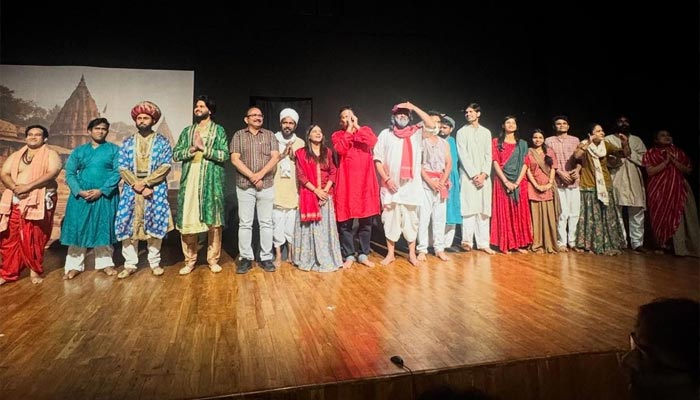
The Hindi play ‘LOI’ was soulfully staged at Veda Kunba Theatre, captivating Mumbai’s theatre audience with its powerful narrative and performances.
Penned by acclaimed poet-lyricist Pratap Somvanshi and directed by Akashaditya Lama, with co-direction by Vikram TDR, the play reimagines the life of Loi—a courageous woman from 15th-century Kashi, often remembered only in relation to Kabir.
Rather than portraying her as a silent companion, the play presents Loi as a strong, questioning voice who stood against patriarchy, caste discrimination, and religious dogma. Inspired by Shekhar Sen’s iconic solo play ‘Kabir’, the narrative gives Loi a central, assertive identity rooted in intellect and resistance.
A compelling aspect of the play is its portrayal of Loi fearlessly challenging authority—whether confronting orthodox figures or raising her voice in the time of Sikandar Lodi. Notably, she even questions Kabir’s own verses when they seem critical of women, adding depth and boldness to the storytelling.
The climactic courtroom scene stands out, where Loi passionately denounces communal divides and societal restrictions on women, advocating instead for humanity and equality. This moment forms the emotional and ideological peak of the production.
The ensemble cast—including Vikram TDR, Mitali Nag, Mukul Nag, Aditi Mishra, Punesh Tripathi, Sohail Malia, Mehreen Saba, Apurva Mahesh, Reshma Mestry, Durgesh, Prateek Mahalle, and Arunoday Vajpai—delivered measured and engaging performances. The portrayal of Loi was particularly striking, capturing the character’s courage, sensitivity, and rational spirit.
With deft direction, Akashaditya Lama maintained the play’s pace and thematic intensity throughout. The intimate ambiance of Veda Kunba Theatre enhanced the immersive experience, while Somvanshi’s sharp, thought-provoking dialogues resonated strongly with contemporary relevance.
Warmly received by Mumbai’s theatre lovers, ‘LOI’ emerges not just as a historical narrative but as a meaningful reflection of present-day society—urging audiences to rethink equality, question prejudice, and embrace humanity.
Comments are closed.