

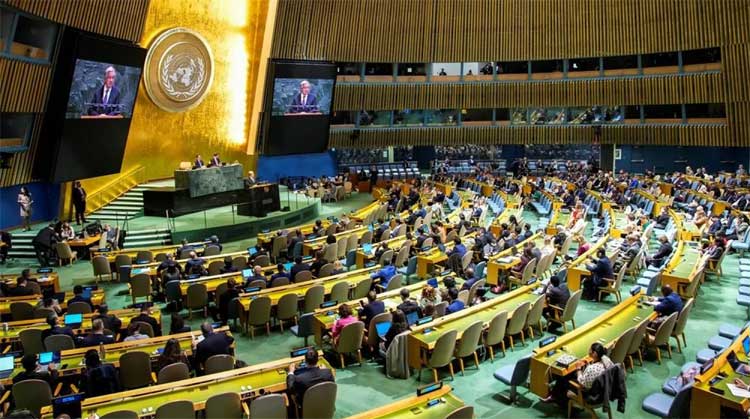
Delegates gathered at the United Nations on Monday for a crucial review of the Nuclear Non-Proliferation Treaty (NPT), as mounting geopolitical tensions raise fears of a renewed global nuclear arms race.
Speaking at the opening, UN Secretary-General António Guterres warned that the forces driving nuclear weapons proliferation are accelerating. He said the treaty—long seen as the cornerstone of global non-proliferation—has been steadily weakening, with commitments unmet and trust eroding. Urging urgent action, Guterres called on nations to “breathe life” back into the agreement.
The meeting comes amid heightened global friction, casting doubt over what the conference can realistically achieve. Jean-Noël Barrot, France’s foreign minister, cautioned that the risk of nuclear proliferation is at its highest in years, pointing specifically to concerns over Iran and North Korea.
Presiding over the conference, Đỗ Hùng Việt, Vietnam’s UN ambassador, tempered expectations, acknowledging that deep-rooted strategic rivalries are unlikely to be resolved. However, he emphasized that even a modest agreement reaffirming core commitments could help strengthen the treaty’s credibility. He warned that the stakes extend far beyond the conference, with the possibility of a new arms race looming.
The NPT, signed by nearly every country—though notably not India, Pakistan, and Israel—aims to curb the spread of nuclear weapons, promote disarmament, and encourage peaceful nuclear cooperation.
According to the Stockholm International Peace Research Institute (SIPRI), the world’s nine nuclear-armed states possessed 12,241 warheads as of January 2025. The United States and Russia together account for nearly 90% of that total and have both undertaken extensive modernization efforts. Meanwhile, China is rapidly expanding its arsenal, drawing concern from global powers.
Recent developments have further fueled anxiety. Donald Trump has signaled interest in resuming nuclear testing, while Emmanuel Macron announced plans to strengthen France’s nuclear deterrent.
Observers warn that consensus will be difficult to achieve. Seth Shelden of the International Campaign to Abolish Nuclear Weapons noted that trust in the NPT framework is deteriorating both within and outside the treaty. Past conferences in 2015 and 2022 failed to produce unified declarations due to disputes involving Middle East policy and the war in Ukraine.
This year’s summit faces multiple flashpoints, including the war in Ukraine, tensions surrounding Iran’s nuclear program, and North Korea’s expanding arsenal. The United States and allies such as United Kingdom, United Arab Emirates, and Australia have also objected to Iran holding a leadership role at the conference, calling it a challenge to the treaty’s credibility.
Another emerging concern is the role of artificial intelligence in nuclear command systems, with several countries pushing to ensure that humans retain ultimate control over nuclear weapons decisions.
As discussions unfold over the coming weeks, the outcome of this conference could significantly shape the future of global nuclear stability.
Comments are closed.