
MI vs RCB: Virat Kohli slows the fast lane, drives RCB with street-smart brilliance

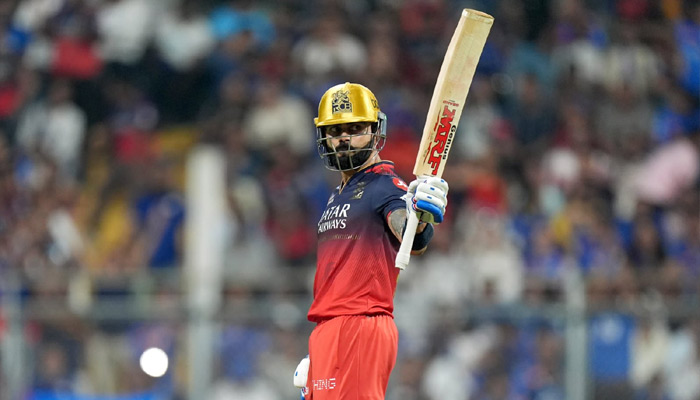
For nearly two decades, Virat Kohli has been the beating heart of Royal Challengers Bengaluru. On Sunday at the Wankhede Stadium, however, the engine hummed on—without its main piston firing at full throttle.
Against the Mumbai Indians on a surface tailor-made for excess, Kohli’s 38-ball fifty felt strangely out of tune with the chaos around him. In an innings that demanded relentless acceleration, he resembled an auto-rickshaw stuck in the fast lane of a Ferrari highway—moving, but never quite keeping up.
Inserted on a dewy evening, RCB knew the equation beforehand: 200 was only par, not protection. The Impact Player rule has redrawn the boundaries of T20 batting—what was once daunting is now merely competitive. With Mumbai’s firepower looming, the margin for conservatism had effectively vanished.
And yet, for stretches, Kohli seemed to bat in a different time zone—one where pacing an innings still had currency, where a strike rate in the 130s did not trigger alarm. In today’s game, that template is rapidly fading. Every dot ball carries a cost; every lull invites scrutiny. There is always another hitter waiting.
Kohli’s fifty came off 38 balls.
RCB still made 240.
The contrast was stark. Phil Salt tore into the attack with a 36-ball 78, striking at over 200. Rajat Patidar turned the middle overs into a highlight reel, smashing 53 off 20 balls. Tim David finished with customary force. Around them, Kohli’s innings didn’t anchor so much as drift.
Ordinarily, a sub-150 strike-rate fifty while setting a target on such a pitch risks becoming a liability. This time, it didn’t. Salt’s assault covered the gap; Patidar ensured there was no let-up.
The new pressure point
Now mentoring Lucknow Super Giants, Kane Williamson recently spoke about how the Impact Player rule has altered a batter’s mindset. With line-ups stretching to No. 8 or 9, the incentive is simple: maximise from ball one.
The traditional idea of building an innings—moving through phases—is giving way to constant aggression. While Williamson’s comments were framed around Rishabh Pant, they echo across the format.
Kohli, to his credit, has largely kept pace with this shift.
An outlier, not a trend
Since 2023, his Powerplay strike rate has climbed to 153, a significant jump from earlier seasons. He has continued to produce fifties at tempo, adapting his game to the format’s new demands.
Which is why this knock stood out.
There was no celebration when he reached his fifty in the 15th over. At the other end, Patidar was on 46 off 13. Two balls later, Kohli mistimed a full toss from Hardik Pandya and departed—his frustration spilling over as he tossed his gear aside.
The innings had begun fluently. He whipped Trent Boult for a six, surged to 22 off 14 in the Powerplay, and looked set. But the tempo dipped soon after. A quiet over against Mitchell Santner stalled momentum, and he never quite regained rhythm.
Around him, the game only sped up.
When even Kohli feels the squeeze
As he inched towards his fifty, even the improbable entered the conversation—should he be retired out?
The optics were striking: Tim David padded up, waiting; the run rate soaring; the urgency palpable. Dale Steyn pointed out Kohli would have wanted to be further ahead, while Sunil Gavaskar noted his reduced strike in the Powerplay.
It was a fleeting discussion, but a revealing one.
This was not decline. It was disruption.
T20 cricket is accelerating at a pace where even the most accomplished players can occasionally be left momentarily out of sync. The role of the anchor is shrinking, if not disappearing altogether.
Kohli understands this better than most. His evolution over the past few seasons reflects that awareness.
Which is why this felt like what it was: an aberration.
Comments are closed.