
Myanmar Crisis: Southeast Asian Leaders Denounce Ongoing Violence, Maintain Ban On Junta Leader

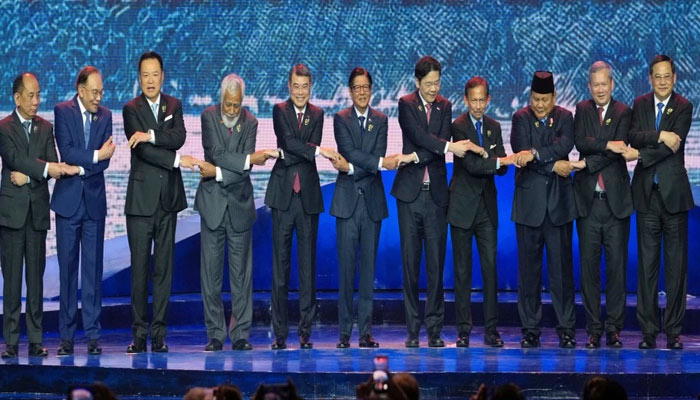
ASEAN Leaders Condemn Myanmar Violence, Continue Ban On Junta Leadership
Leaders of the Association of Southeast Asian Nations (ASEAN) on Sunday criticised Myanmar for failing to implement a peace agreement reached in 2021, expressing concern over continued attacks on civilians by the military and other armed groups. They also decided to maintain restrictions preventing Myanmar’s top leadership from participating in the bloc’s annual summit meetings.
The strong criticism came as ASEAN leaders began their annual summit in Manila, the Philippine capital. The decision followed an assessment of the military-backed administration’s progress in implementing the five-point peace plan. Myanmar remains a member of the 11-country regional grouping.
The peace initiative was adopted in April 2021, shortly after Myanmar’s military seized power from the elected government led by Aung San Suu Kyi. The coup sparked widespread pro-democracy demonstrations, which were violently suppressed by security forces. The crackdown subsequently fuelled armed resistance and plunged the country into a civil war that has affected large parts of Myanmar.
ASEAN Expresses Concern Over Continued Attacks
In their latest statement, ASEAN leaders expressed “deep concern” over the lack of meaningful progress in implementing the peace agreement. They called on all parties involved in the conflict, particularly the armed forces, security agencies and armed groups, to reduce hostilities and end attacks on civilians and civilian infrastructure.
The leaders also stressed the need to build confidence among the stakeholders to create conditions for a peaceful resolution.
Last month, a United Nations human rights investigator accused Myanmar’s military-backed government of deliberately targeting civilians to spread fear and compel people to surrender.
According to figures compiled by the Assistance Association for Political Prisoners, an independent organisation monitoring arrests and deaths linked to the conflict, Myanmar’s security forces had killed more than 8,600 people and arrested 32,406 others as of Friday.
Ban On Myanmar’s Top Leaders To Continue
ASEAN leaders confirmed that Myanmar’s leader and foreign minister would remain barred from attending the bloc’s summit-level meetings until substantial progress is achieved under the peace plan.
The agreement includes an immediate cessation of violence and the initiation of dialogue among conflicting parties under the mediation of an ASEAN-appointed special envoy.
As a result of the restrictions, Myanmar can send only non-political representatives, such as career diplomats, to ASEAN meetings, including the ongoing summit in Manila.
Myanmar was originally scheduled to assume ASEAN’s rotating chairmanship this year and host several regional meetings. However, the continuing conflict led to the Philippines taking over the responsibility.
Philippine Foreign Secretary Theresa Lazaro, who currently serves as ASEAN’s special envoy to Myanmar, said the regional bloc would continue monitoring developments.
“There’s still certain bombings and displacement of Myanmar people so step-by-step, we give it to them, how they’re going to tackle this issue, and we’ll monitor that,” Lazaro said at a news conference in Manila.
Myanmar’s New President Faces International Isolation
The three-day ASEAN summit is also expected to address several regional and international conflicts, including Myanmar’s civil war. Discussions are scheduled with global leaders, including US President Donald Trump, according to draft post-summit statements reviewed by The Associated Press.
Min Aung Hlaing, who led the February 2021 military coup against Suu Kyi’s government while serving as army chief, took oath as Myanmar’s president in April. His appointment followed elections conducted in phases during December and January.
Opponents and critics rejected the election process, describing it as an attempt by the military to strengthen its hold on power while presenting the transition as a return to civilian governance.
Since becoming president, Min Aung Hlaing has travelled to five ASEAN member countries, including Thailand, Malaysia and Vietnam, as part of efforts to rebuild diplomatic relations and secure international recognition. However, he continues to face significant isolation on the global stage.
Although ASEAN has not opposed his visits to member countries, the bloc’s leaders reiterated that the five-point peace agreement remains “the main reference for addressing the political crisis in Myanmar.”
They added that Myanmar’s full political representation in ASEAN could be restored gradually if the country demonstrates “sustained and concrete progress” in implementing the agreement. However, the leaders did not specify what steps or timeline would be required for lifting the restrictions.
Comments are closed.