

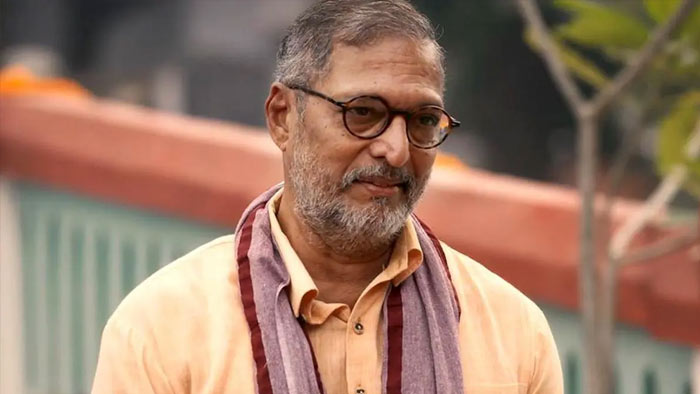
Veteran actor Nana Patekar died at the age of 75 on Thursday, October 8, after being found unresponsive at his flat in Goa. According to ANI, Patekar suffered a cardiac arrest and was declared dead at Manipal Hospital at 5:20 am.
The actor had complained of severe chest pain during the early hours of the morning. His son, Malhar Patekar, said a medical team was called to the actor’s residence after he began feeling unwell. Patekar was found unresponsive when the team arrived, and attempts were made to revive him before he was taken to hospital.
Doctors at Manipal Hospital continued efforts to resuscitate him for around 45 minutes, but he could not be revived.
Since Patekar was not a registered patient at the hospital, the medical team informed the police following his death. His body was taken to Goa Medical College for a post-mortem examination.
Patekar’s last rites will be performed at his farmhouse in Pune, according to his family’s wishes. Maharashtra Cultural Affairs Minister Ashish Shelar announced that the state government would accord him a state funeral with full honours, recognising his contribution to Marathi theatre as well as Hindi and Marathi cinema.
Nana Patekar’s final hours
Dr Shekhar Salkar, Chief of Oncology at Manipal Hospital, later shared details about the actor’s final hours.
Patekar was brought to the hospital in an unresponsive state at around 4 to 4:30 am. Doctors performed cardiac massage for approximately 45 minutes to an hour but were unable to revive him.
According to the doctor, Patekar had contacted someone at around 2:30 am and sent a message to a friend saying he was unwell. The friend did not see the message immediately and later called him before going to the actor’s residence.
By around 4 am, Patekar was reportedly sweating and becoming increasingly unresponsive. His caretaker contacted the hospital, following which an emergency medical team travelled to his flat in an ambulance and began resuscitation.
Nana Patekar’s final public appearance
Patekar’s last public appearance came on October 4 at the Samraat Club International installation ceremony in Dona Paula, Goa, just days before his death.
During his speech, the veteran actor fondly remembered former Goa Chief Minister Manohar Parrikar, whom he described as a friend. He praised Parrikar’s stature and his commitment to public life.
Patekar also reflected on mortality and the limited time available to every individual.
“We all have to go someday. I don’t know whether I will be here tomorrow or not,” he said, adding that before that moment arrives, people should ask themselves whether they are doing what they truly want to do.
From Gaman to a National Award-winning career
Patekar studied at Mumbai’s Sir J.J. School of Art before entering theatre and subsequently moving into films. He made his Hindi film debut with Gaman in 1978.
His early work included films such as Aaj Ki Awaaz, Pratighaat, Mohre and Trishagni. His performance in Ankush (1986) brought him greater recognition, while Vidhu Vinod Chopra’s Parinda (1989) proved to be a major breakthrough.
Patekar’s portrayal of gangster Anna in Parinda earned him the National Film Award for Best Supporting Actor and a Filmfare Award in the same category.
- Krantiveer and the height of his 1990s success
- The 1990s established Patekar as one of Hindi cinema’s most powerful performers.
He won the Filmfare Award for Best Villain for Angaar (1992) and followed it with prominent roles in films such as Tirangaa.
His performance as Pratap Narayan Tilak in Krantiveer (1994) earned him the National Film Award for Best Actor and the Filmfare Award for Best Actor.
Two years later, he won another National Film Award for Best Supporting Actor for Agni Sakshi. His work in Khamoshi: The Musical further showcased his ability to move between intense roles and emotionally driven drama.
- Ab Tak Chhappan, Apaharan and Welcome
- Patekar remained a prominent figure in Hindi cinema in the 2000s.
He played police officer Sadhu Agashe in Ab Tak Chhappan (2004), earning widespread praise for his portrayal of a tough and conflicted cop. In Apaharan (2005), he played a politically connected character and won the Filmfare Award for Best Villain.
But his range extended well beyond serious drama.
In Welcome (2007), Patekar transformed into the comic gangster Uday Shetty, a role that introduced his work to an even wider mainstream audience. He reprised the character in Welcome Back (2015).
- He also featured in political drama Raajneeti (2010).
- A lasting connection with Marathi cinema
Marathi cinema remained an important part of Patekar’s career despite his success in Hindi films.
His performance in Natsamrat (2016), in which he portrayed a retired theatre actor dealing with ageing, family and loss, was particularly acclaimed. The role earned him the Filmfare Award for Best Actor in Marathi cinema.
Patekar’s filmography reflected an unusual ability to move between commercial entertainers and performance-led cinema without losing his distinctive identity.
Beyond acting
Patekar also explored filmmaking, making his directorial debut with Prahaar: The Final Attack in 1991. The film, which drew inspiration from military life and soldier training, also featured him in the lead role.
His contribution to social work was another significant part of his life. In 2015, he and actor Makarand Anaspure founded the Naam Foundation, which works with communities affected by drought and other challenges faced by farmers in Maharashtra.
Patekar also served in the Territorial Army and was conferred the honorary rank of Lieutenant Colonel.
He continued acting into his seventies, with his recent credits including Vanvaas (2024), Housefull 5 (2025), O’ Romeo and Subedaar in 2026.
From theatre to Hindi and Marathi cinema, and from intense dramatic roles to comedy, Nana Patekar leaves behind a career spanning more than four decades and a body of work that made him one of Indian cinema’s most recognisable performers.
Comments are closed.