
Nepal Deploys AI to Strengthen Climate Resilience Against Landslides

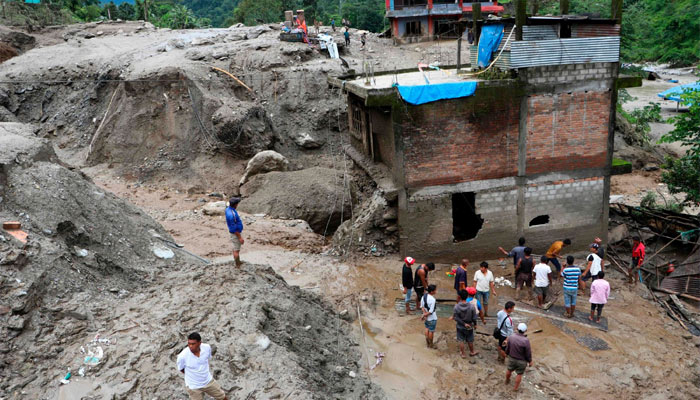
Nepal Trials AI Landslide Warning System in High-Risk Villages.
In the remote hills of northwest Nepal, primary school teacher Bina Tamang begins each day by checking a rain gauge outside her home. The data she collects feeds into a new AI-powered landslide early warning system — part of a pilot project in one of the world’s most landslide-prone regions.
Developed by researchers at the University of Melbourne in collaboration with partners in Nepal, the UK, and Italy, the system uses a mix of rainfall measurements, ground movement data, satellite imagery, and local reports to forecast landslides up to weeks in advance.
Tamang, 29, lives in Kimtang village, where unstable terrain and regular landslides pose constant danger. “Our village is in difficult terrain, and landslides are frequent,” she said. “But I am hopeful this early warning system will help save lives.”
Each year, during the monsoon season, landslides kill hundreds across South Asia. In Nepal alone, they accounted for over 70% of all monsoon-related deaths last year, government data shows.
Nepal’s vulnerability stems from a combination of unstable geology, shifting rainfall patterns, and haphazard development. “Climate change is only making it worse,” said Rajendra Sharma from the National Disaster Risk Reduction and Management Authority. “Rain is falling where snow once did, and even wildfires are accelerating soil erosion.”
The AI platform, called SAFE-RISCCS (Spatiotemporal Analytics, Forecasting and Estimation of Risks from Climate Change Systems), is designed to be low-cost, scalable, and community-driven.
“We’re applying proven forecasting principles already used in the U.S. and China but tailored for Nepal’s terrain,” said Prof. Basanta Adhikari of Tribhuvan University, a partner in the project. It’s currently being tested in Kimtang (Nuwakot district) and Jyotinagar (Dhading district), both high-risk zones.
The data collected by locals like Tamang is analyzed in Kathmandu by technical experts such as Sanjaya Devkota. “Once we build a year or two of data, the AI will be able to generate alerts and visual risk maps in real time,” Devkota said.
Eventually, the system aims to provide continuous risk assessments to help officials and residents take preventive measures and plan evacuations. “This doesn’t need to be resource-intensive,” said project lead Prof. Antoinette Tordesillas. “It works because it taps into deep local knowledge.”
Nepal has seen some success in reducing flood fatalities through river sirens and community-based alerts. But experts say landslides are harder to predict. “Flood warning has improved — we’ve installed over 200 sirens,” said government hydrologist Binod Parajuli. “But landslides are more complex. We urgently need systems like this to reduce our monsoon death toll.”
Asia experienced more climate-related disasters than any other region in 2023, according to the UN. Yet early warning coverage remains uneven. Nepal’s efforts may offer a promising model for other vulnerable nations seeking to close that gap.
Comments are closed.