

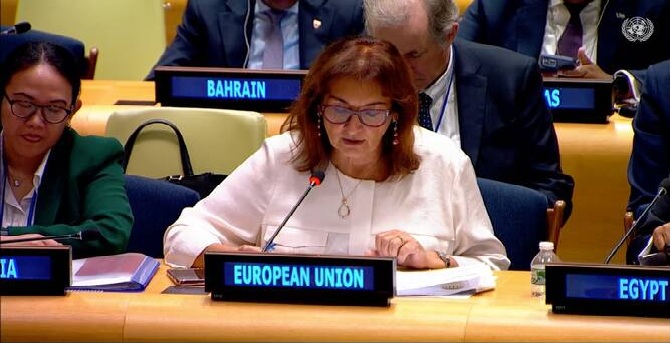
EU and Gulf Nations Show United Front on Palestinian Peace Push.
The European Union and Gulf nations, led by Saudi Arabia, are increasingly aligned in their efforts to achieve a ceasefire between Israel and Hamas and to advance a long-term political solution for Gaza and the West Bank. The convergence of views was highlighted this week at a high-level international conference at the United Nations in New York, aimed at reviving momentum for a two-state solution.
Dubravka Šuica, the EU’s Commissioner for Democracy and Demography and special envoy for the Mediterranean, told Arab News that the two blocs share a common goal: establishing “peace, security, and prosperity” for both Palestinians and Israelis. She described the event as a possible turning point.
“This is a historic moment. We are mature enough, and seeing what is happening on the ground, this conference might be the trigger to say: enough is enough,” she said.
The two-day summit—officially titled High-Level International Conference for the Peaceful Settlement of the Question of Palestine and the Implementation of the Two-State Solution—was co-chaired by Saudi Arabia and France. It brought together representatives from the EU, UN, and key Arab states, reflecting what many see as the most coordinated international effort on the issue in over a decade.
Šuica voiced strong support for the Saudi-led Arab Peace Initiative and stressed the need for a ceasefire and a political roadmap that offers security and sovereignty for both sides. “We are aligned on that. We would like to follow, we would like to engage,” she said.
Beyond diplomacy, the EU is also playing a major financial role, including support for the Palestinian Authority. “We don’t want to be only a payer—we want to be a player,” Šuica said. “We are financing the Palestinian Authority because we believe empowering them is key to building lasting peace.”
The EU is preparing to launch a donor coordination platform in the fall, aimed at mobilizing aid for Gaza’s reconstruction and institutional development. A total of €1.9 billion has been earmarked for Palestinian reforms through 2027, with €150 million already disbursed. The EU is also providing critical support to the UN Relief and Works Agency (UNRWA), which remains the only body delivering education, healthcare, and essential services inside Gaza.
However, Šuica stressed that the long-term vision is for the Palestinian Authority to take over these services. “Ultimately, we want them to govern independently,” she said.
Addressing the broader political context, she acknowledged tensions in EU-Israel relations, particularly Israel’s recent withholding of Palestinian tax revenues and continued settler violence in the West Bank.
“Violent settlers on the ground is not acceptable,” she said, adding that although the EU has introduced limited sanctions, further action is hindered by the need for unanimous agreement among member states. She also noted that Israel had breached Article 2 of the EU-Israel Association Agreement, but there was no consensus to suspend the pact altogether. “We need a channel of communication with Israel. If we block everything, who is our interlocutor?”
Despite these challenges, Šuica said the EU remains united on one point: delivering humanitarian aid to Gaza. “All member states are on board,” she confirmed, while criticizing Israel’s slow implementation of aid corridor agreements.
Looking ahead, she pointed to September’s UN General Assembly week as a key milestone. France has announced it will officially recognize the State of Palestine, and Šuica hinted that other European countries may follow. “This is a very good introduction,” she said of the New York conference. “Announcements are expected.”
This renewed momentum is part of the broader Peace Day Effort launched by the EU, the Arab League, Saudi Arabia, Jordan, and Egypt. It envisions a comprehensive support package—combining economic assistance, diplomatic backing, and regional security guarantees—to sustain peace once a final agreement is reached.
“This is not just about Gaza,” Šuica said. “This is about building the future architecture of peace and security in the region. And Gulf countries are critical partners. We are aligned, and we are determined.”
As the humanitarian crisis in Gaza deepens and violence spreads across the West Bank, pressure is mounting on all sides to convert diplomatic alignment into lasting, on-the-ground change.
Comments are closed.