
Political Storm In Poland: Judge Suspends Court President, Sparks Street Protests And Coup Claims

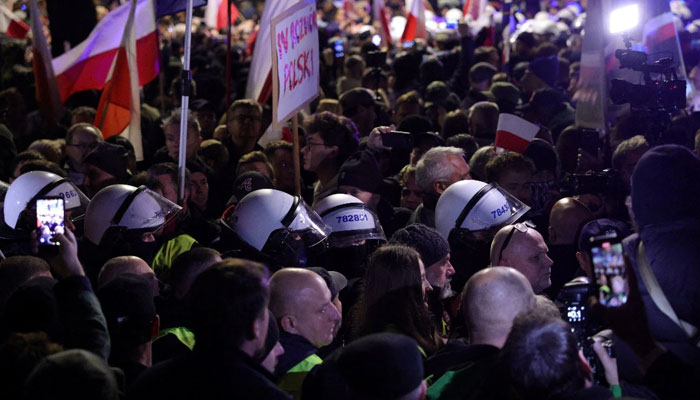
Constitutional Showdown In Poland: Judge Suspends Top Court Officials, President Rushes Back From Senegal
Poland is facing a major constitutional confrontation after a judge announced the suspension of the country’s Constitutional Tribunal president and vice president, triggering protests, a police deployment and accusations of an attempted coup. The escalating dispute also prompted President Karol Nawrocki to abandon his visit to Senegal and return to Warsaw.
The controversy erupted on October 30, when a notice appeared on the Constitutional Tribunal’s website announcing the suspension of its president, Bogdan Swieczkowski, and Vice President Bartlomiej Sochanski. The announcement was made by Judge Anna Korwin-Piotrowska, the Tribunal’s longest-serving member, who said the decision was necessary to restore the rule of law. She subsequently declared herself the institution’s acting head.
The court’s website became inaccessible shortly after the announcement, further deepening the uncertainty surrounding the decision.
Nawrocki Cuts Short Senegal Trip As Protests Erupt
Polish President Karol Nawrocki was travelling to Senegal when the suspension was announced. He immediately decided to return to Poland, explaining that the situation required his presence in the country.
“At a moment like this, the President must be in Poland. I am cutting short my flight to Senegal. I am returning,” Nawrocki wrote on X.
Meanwhile, riot police were deployed outside the Tribunal, and barricades were erected around the building. Dozens of protesters assembled to oppose the suspension, with some chanting slogans against Prime Minister Donald Tusk.
The Tribunal’s official X account described the development as a “coup d’etat”, highlighting the seriousness of the institutional confrontation.
On Saturday morning, Nawrocki’s chief of staff, Pawel Szefernaker, confirmed that the president had entered the Tribunal building accompanied by Supreme Court First President Zbigniew Kapinski.
Ambassador To China Resigns Amid Political Turmoil
The crisis also triggered repercussions within Poland’s diplomatic establishment. Ambassador to China Jakub Kumoch announced that he was stepping down, saying the situation in Poland had made it impossible for him to continue representing the country.
In his resignation announcement on X, Kumoch said he had submitted his resignation and requested his formal recall.
Foreign Minister Radosław Sikorski responded by criticising the ambassador’s decision, calling the conclusion of his diplomatic assignment unprofessional and stating that he no longer represented the Republic of Poland.
Sikorski made the remarks while attending the G20 Summit in the United States.
How Poland’s Judiciary Became A Political Battleground
The latest confrontation is rooted in years of disagreement over judicial reforms and the independence of Poland’s courts. The Constitutional Tribunal has remained a major flashpoint between the current government and the national-conservative Law and Justice party (PiS), which governed Poland from 2015 to 2023.
During its tenure, PiS introduced extensive changes to the judicial system. Critics in Poland and the European Union accused the party of increasing political influence over important judicial institutions.
The dispute also brought Warsaw into conflict with Brussels. The EU raised concerns about the independence of Poland’s judiciary and imposed financial penalties. The Constitutional Tribunal’s rulings, including decisions favouring Polish legislation over certain EU legal provisions, further intensified the disagreement.
Tusk Government Faces Resistance Over Judicial Reforms
Prime Minister Donald Tusk’s pro-European coalition came to power in 2023 with a promise to restore judicial independence and reverse controversial changes introduced by the previous administration.
However, implementing these reforms has proved difficult. Two successive presidents aligned with PiS, including Nawrocki, have blocked several government initiatives through presidential vetoes.
Tusk’s government has also been attempting to address judicial appointments made during PiS rule. Swieczkowski, who became Tribunal president under the previous administration, has been accused by Tusk of preventing judges selected by the current parliamentary majority from taking their positions.
Defending his government’s actions, Tusk said on X that restoring the rule of law was an obligation, even if the process was difficult and involved decisive measures.
Speaking at Campus Polska in August, he had also outlined plans to ensure that the Tribunal was staffed with judges appointed lawfully, acknowledging that the approach might not satisfy everyone.
PiS Calls Suspension An Attack On Constitutional Order
The opposition PiS leadership has strongly rejected the suspension of the Tribunal’s top officials. Former Justice Minister Zbigniew Ziobro described the development as a serious attack on Poland’s constitutional framework and called on supporters to organise firm and united resistance.
The latest dispute has brought Poland’s political and judicial divisions into sharp focus. With the government defending its efforts to reform the judiciary and the opposition accusing it of violating constitutional principles, the confrontation has raised fresh questions about the authority, independence and future functioning of the Constitutional Tribunal.
Comments are closed.