
Post-Diwali Pollution Pushes Delhi AQI To 384, City Nears Severe Air Quality Category

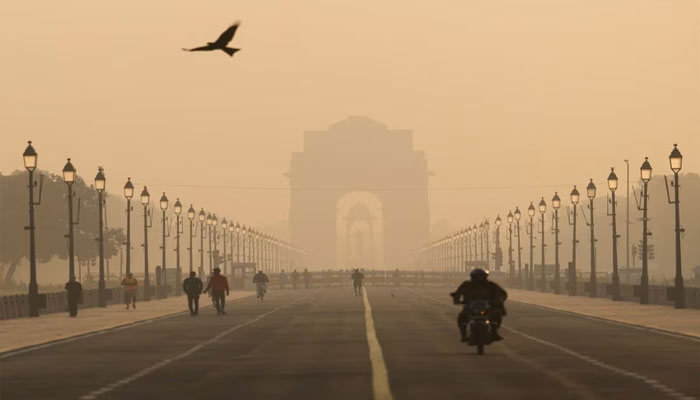
Delhi’s AQI Touches 384 On Diwali Morning, 11 Areas Slip Into Severe Pollution Zone
Delhi began Diwali under a thick blanket of pollution, with the city’s overall Air Quality Index (AQI) touching 384 on Sunday morning, placing it in the ‘very poor’ category, according to the Central Pollution Control Board (CPCB).
The situation was significantly worse in several parts of the capital, where pollution levels crossed the 400 mark and entered the ‘severe’ category. Data from 23 monitoring stations showed that 11 locations had severe air quality, while the remaining 12 recorded readings in the very poor range.
Punjabi Bagh topped the list of polluted areas with an AQI of 450. RK Puram followed at 449, while IIT Delhi recorded 446 and Dwarka registered 444.
CRRI Mathura Road and Siri Fort both reported an AQI of 425. North Campus of Delhi University and Chandni Chowk recorded 423 each. Pusa registered 415, Burari Crossing 411 and NSUT Jaffarpur 409.
Other locations also continued to report elevated pollution levels. Narela recorded 399, ITO 396 and Mandir Marg 393. Uttam Nagar stood at 373, Burari at 370, while Talkatora Garden and Aya Nagar both registered 369.
Vasundhara Enclave recorded an AQI of 356, followed by Tikri Kalan and Badarpur at 349 each. Karala registered 337, Lodhi Road 333 and Anand Vihar 328.
VEHICLE EMISSIONS, STUBBLE BURNING ADD TO DELHI’S POLLUTION
The worsening air quality has been attributed to multiple factors, including slow wind speeds, unfavourable weather conditions, vehicular emissions, Diwali-related activities and crop-residue burning in neighbouring states.
The air quality warning system indicated that low ventilation and average wind speeds of below 10 kilometres per hour could restrict the movement of pollutants, allowing them to accumulate in the atmosphere. PM10 was identified as the primary pollutant in Delhi on Saturday.
According to the Delhi government’s Decision Support System (DSS), transport was the biggest contributor to the city’s pollution load on Saturday, accounting for an estimated 21.4 per cent.
Stubble burning contributed 1.7 per cent to Delhi’s pollution on Saturday, with its share projected to increase to 5.4 per cent on Sunday, as reported by PTI.
Satellite monitoring detected 589 farm-fire incidents across six states on Friday. Punjab accounted for the highest number at 357, followed by Madhya Pradesh with 139 and Rajasthan with 58. Uttar Pradesh recorded 23 cases, Haryana nine and Uttarakhand three.
Between September 15 and November 6, a cumulative 6,226 crop-residue burning incidents were detected across the six states, according to a bulletin from the CREAMS Laboratory of the Indian Agricultural Research Institute.
STAGE III GRAP RESTRICTIONS CONTINUE IN DELHI-NCR
Amid mounting concerns over pollution ahead of the festival, the Commission for Air Quality Management (CAQM) imposed Stage III restrictions under the Graded Response Action Plan (GRAP) across Delhi-NCR on Friday, November 6.
The measures prohibit non-essential construction and demolition work that generates dust. Stone crushers and mining-related activities have also been ordered to remain restricted.
Restrictions have been imposed on BS-III petrol and BS-IV diesel light motor vehicles in Delhi and the NCR districts of Gurugram, Faridabad, Ghaziabad and Gautam Buddh Nagar. Certain categories of diesel goods vehicles are also covered under the curbs.
Schools up to Class V have been given the option of conducting classes in hybrid mode, allowing students to attend either online or in person. Government and private offices may also consider operating with 50 per cent of their workforce working from home.
Authorities have urged residents to minimise the use of private vehicles, opt for public transport and consider carpooling. Walking and cycling have also been encouraged for shorter distances. The burning of coal and wood for heating has been discouraged.
With Diwali celebrations coinciding with already elevated pollution levels, the capital faces additional challenges in containing emissions. Unfavourable weather, vehicle exhaust and seasonal stubble burning continue to put pressure on air quality.
The continued enforcement of GRAP Stage III restrictions is aimed at limiting pollution sources and preventing the situation from worsening further across Delhi-NCR.
Comments are closed.