
“Research Finds Mars Plays a Bigger Role in Earth’s Climate Than Expected”

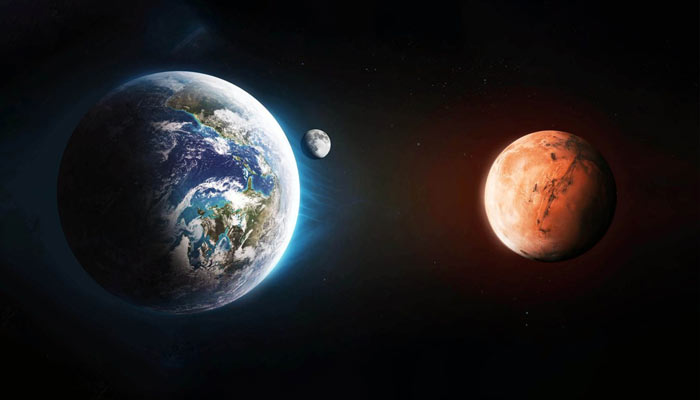
Mars Has a Bigger Impact on Earth’s Climate Than Scientists Thought, Study Finds
New simulations reveal that Mars plays a far stronger role in shaping Earth’s long-term climate than previously believed. The Red Planet’s gravity affects Earth’s tilt and orbit, influencing climate cycles that span hundreds of thousands to millions of years—even though Mars is smaller than giants like Jupiter.
For decades, scientists have known that Earth’s long-term climate is influenced by Milankovitch cycles—slow shifts in Earth’s orbit and axial tilt caused by the gravitational pull of other planets. Venus and Jupiter were considered the main drivers, while Mars was thought to have a minor role.
The new study, led by Stephen Kane (University of California, Riverside) with collaborators in the UK and Australia, used advanced simulations to test Mars’ influence. The results show that removing Mars from the calculations completely eliminates two major cycles, roughly 100,000 and 2.4 million years long, and that increasing Mars’ mass amplifies its effects.
Mars also helps stabilize Earth’s tilt. Simulations indicate that its gravity slows changes in Earth’s axial tilt, challenging the long-held view that the Moon alone maintains stability. Earth’s tilt normally fluctuates between 21.5° and 24.5° over 41,000-year cycles, while Mars’ irregular tilt provides a balancing effect.
Finally, Mars’ location in the solar system strengthens its influence. Kane explained that despite its smaller size, Mars’ distance from the Sun allows it to exert a greater gravitational impact than expected, helping shape Earth’s climate over millions of years.
Comments are closed.