

The United Kingdom’s relationship with China has undergone dramatic reversals over the past decade — from the optimism of a much-touted “golden era” to a phase marked by mistrust, security anxieties and fading economic returns.
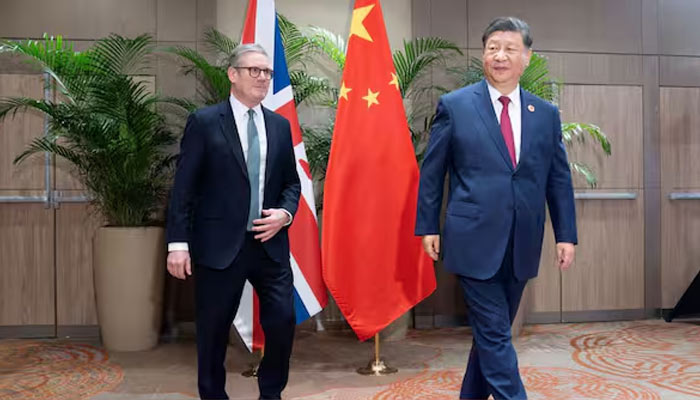
Against this volatile backdrop, Prime Minister Keir Starmer’s visit to China — the first by a British leader in eight years — signals a cautious attempt to stabilise a relationship that has frayed on nearly every front. Starmer is scheduled to meet President Xi Jinping on Thursday and is accompanied by a delegation of around 60 British business and cultural figures, including senior representatives from HSBC, GSK, Jaguar Land Rover and the National Theatre.
Beijing has cast the visit as an opportunity to “open a new chapter of healthy and stable development” in bilateral ties, language that reflects China’s broader push to reset relations with Western economies after years of diplomatic freeze.
For Starmer, the visit is a balancing act. His government wants to revive economic engagement and reopen channels of dialogue weakened since 2020, while avoiding any dilution of the security-first approach that now underpins Britain’s China policy. The timing is also shaped by global uncertainty, as President Donald Trump’s unpredictable handling of alliances has unsettled traditional Western strategic assumptions.
At its core, London’s dilemma is whether pragmatic engagement with China can be pursued without compromising national security or core political values.
Where Relations Stand
A decade ago, London and Beijing were celebrating what they openly described as a “golden era” of cooperation. That period peaked in 2015, when then prime minister David Cameron hosted Xi Jinping on a highly symbolic state visit. Britain sought to position itself as China’s gateway to Europe, while Beijing viewed the UK as a dependable partner within the Western economic order.
That vision collapsed after Beijing imposed a sweeping national security law on Hong Kong in 2020, triggering a crackdown on dissent in the former British colony. Human rights concerns, allegations of cyber espionage and China’s perceived support for Russia’s war in Ukraine further eroded political trust.
Economic ties deteriorated in parallel. UK exports to China fell 52.6 per cent year-on-year in 2025, according to British government data, underlining the limits of commercial engagement amid rising political friction.
Security concerns came into sharp focus during the Huawei controversy. Despite years of close oversight through a UK-run cybersecurity evaluation centre, a parliamentary inquiry concluded in 2020 that there was “clear evidence of collusion” between Huawei and the Chinese Communist Party apparatus. The findings accelerated Britain’s decision to ban Huawei from its 5G networks and mandate the removal of existing equipment.
Warnings from the intelligence community hardened attitudes further. MI5 director Ken McCallum said last year that Chinese state actors pose a national security threat to the UK “every day”, while a 2023 government review described China as an “epoch-defining challenge”.
Why Starmer Is Visiting Now
Since taking office, Starmer has signalled his intent to place relations with China on a more stable and predictable footing. His government ordered an audit of what it described as Britain’s “most complex bilateral relationship”, but the findings were largely classified, offering little public clarity on policy direction.
Momentum toward engagement resumed after Starmer held a private meeting with Xi Jinping in Brazil and highlighted climate change as an area for cooperation. However, the Beijing visit was delayed by controversy surrounding China’s plans to build a large new embassy in London, with critics warning of potential security risks.
The proposal was approved this week after the government said intelligence agencies had arrangements in place to manage any threats, clearing the way for Beijing to extend a formal invitation.
Starmer’s approach is also influenced by tensions in the transatlantic relationship. Trump’s tariff threats against allies and his confrontational posture on issues such as Greenland have unsettled London, prompting a reassessment of Britain’s strategic room for manoeuvre.
Starmer has said the UK will not be forced to choose between the United States and China, arguing that disengagement from Beijing is neither realistic nor desirable.
What Beijing Wants
For China, the visit offers a chance to demonstrate that it can rebuild functional ties with major Western powers. It follows recent trips to Beijing by leaders including France’s Emmanuel Macron and Canada’s Mark Carney, with Germany’s chancellor expected to visit next month.
Chinese messaging around the visit has focused on economic cooperation and the resumption of suspended dialogue mechanisms, reflecting a preference for pragmatic engagement over ideological confrontation.
Public opinion in Britain may also be softening slightly. A YouGov poll shows the share of Britons who view China as a “friend”, “ally” or “friendly rival” has risen to 27 per cent, up from 19 per cent late last year.
What to Expect
Starmer’s delegation includes senior executives aiming to revive the UK–China CEO Council, which has been largely inactive since relations soured. Its revival would signal London’s willingness to restore commercial links even as geopolitical tensions persist.
Human rights are expected to feature in talks, including the case of Jimmy Lai, the Hong Kong media figure and British citizen convicted under the national security law.
Broader global issues — notably Ukraine and climate change — will also be discussed, though expectations for concrete breakthroughs remain modest.
The visit is best understood as an exercise in managed re-engagement rather than strategic renewal. It reflects a mutual desire to stabilise a deeply strained relationship, not to resurrect the optimism of the “golden era”, but to establish a narrower, more cautious framework for cooperation in an era of sustained mistrust.
Comments are closed.