
Roger Federer Turns Emotional as Wife Mirka Delivers Heartfelt Hall of Fame Tribute

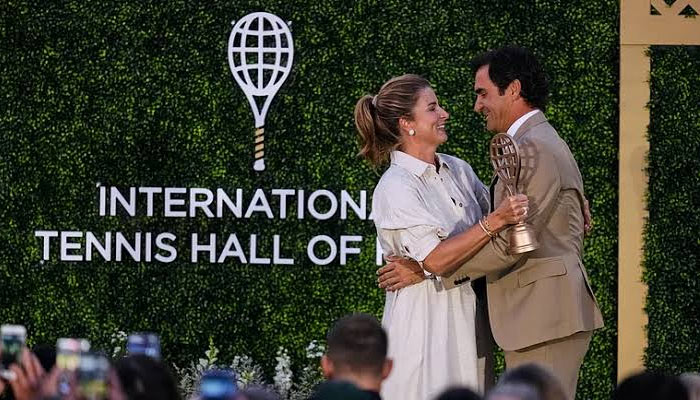
Roger Federer has spent much of his life leaving tennis audiences speechless. At his International Tennis Hall of Fame induction in Newport, it was his wife, Mirka, who turned the tables.
After delivering a deeply personal speech introducing Federer, Mirka stepped away from the microphone. Federer walked over, hugged her and kissed her before wiping tears from his face.
Then he managed to crack a joke.
“She is a good public speaker. I didn’t know that.”
The 45-year-old Swiss admitted he had not heard Mirka speak publicly in years. He recalled that the last occasion was probably during the Hopman Cup, where the couple played mixed doubles together more than two decades ago.
“So this is very well done,” Federer said. “I don’t know if you had been secretly practising. But this is a very high level and a tough act to follow.”
Mirka’s tribute had deliberately avoided turning into a list of Federer’s accomplishments. There was little emphasis on his 20 Grand Slam championships, 103 ATP titles or 310 weeks atop the world rankings.
Instead, she told the story of Roger the husband, father and friend.
FROM SYDNEY TO A LIFE TOGETHER
Mirka began with the Sydney Olympics in 2000, where she first met an 18-year-old Federer. She was 21.
“Yes, I was the older woman,” she joked.
Federer, who had yet to win an ATP title, nevertheless pursued her.
“When we met, he had exactly zero ATP titles. Zero,” Mirka said. “Looking back, I suppose I was there for all 103 that followed.”
As Federer transformed from a promising teenager into a global sporting icon, Mirka was there for almost every stage of the journey. A former professional tennis player, she occasionally helped him prepare before matches.
One of her favourite memories involved Andy Roddick, who joked after losing the Cincinnati final that he could not believe he had been beaten by a player whose girlfriend had warmed him up.
Decades later, the couple still laugh about it.
But Mirka’s message was ultimately about something far more important than old tennis jokes.
She said Federer had always wanted the people he loved close to him. She also witnessed the enormous effort behind the graceful tennis that appeared so natural to spectators.
“I saw the work, the hours, the discipline, the commitment,” she said.
What impressed her most, however, was not what Federer accomplished in stadiums.
“The man behind it all is even more remarkable.”
WHEN FEDER CHOSE FAMILY
Mirka then revealed how strongly family shaped Federer’s career.
When the couple discovered they were expecting twins, Mirka feared that travelling around the tennis circuit with two babies would be impossible. She told Federer that she might have to stop travelling.
- His response was simple.
- “Then I won’t play anymore.”
- Mirka said he meant it.
The family eventually found a way to stay together on tour. Strollers and children’s toys became familiar sights in the players’ world, and their travelling family later grew with the arrival of another set of twins.
Myla, Charlene, Leo and Lenny grew up seeing a very different Federer from the one known by millions of fans.
At home, he was simply Papa — reading bedtime stories, playing games, running baths and finding ways to make his children laugh regardless of what had happened on court.
Mirka said Federer never allowed victories or defeats to take away from his role as a father.
She also credited his parents, Robert and Lynette, with giving him the values that remained central throughout his life.
For Mirka, that was the real measure of his success.
“The trophies and records are extraordinary. But they are only part of his legacy,” she said. “What makes me proudest isn’t what Roger accomplished when the world was watching. It’s who he is when nobody’s watching.”
By then, Federer was already fighting back tears.
Mirka told him that witnessing his career had brought her enormous joy, but that sharing his life had been an even greater privilege.
She ended by introducing him in the most personal way possible.
“My husband, my best friend, and now the newest member of the International Tennis Hall of Fame.”
‘OH GOSH, THIS IS SUCH A MESS’
Federer’s own speech became even more emotional when he eventually addressed Mirka.
He had already spoken warmly about the people who helped shape his career, including his childhood hero Stefan Edberg and longtime coach Severin Lüthi.
But when he reached the subject of his wife, he struggled.
“Now the Mirka part,” he said, before pausing.
“Oh gosh, this is such a mess.”
Federer joked that he needed “tissues and sunglasses” before continuing.
He described Mirka as his wife, but immediately made clear that the title barely covered her role in his life.
She had been his coach, hitting partner, reality check and even his stylist.
“I definitely needed one at that time,” he joked.
Then came the more serious reflection.
Federer said Mirka helped him become more focused on tennis while also teaching him to find joy away from the court. He praised her as an exceptional mother to their four children and described their partnership with a memorable image.
“She and I grab each other’s hands, and we run through walls.”
For someone whose career was defined by remarkable composure, Federer appeared unusually vulnerable as he spoke about the woman who had accompanied him through almost every major chapter of his life.
A HALL OF FAME MOMENT WITHOUT THE EGO
Federer’s induction was supposed to be a celebration of one of the greatest careers in tennis history. Yet the evening became less about statistics and more about relationships.
He reflected on growing up in Basel, his memories as a ball boy and the players he once admired from afar. He thanked his parents, coaches, opponents, friends and supporters.
The achievements were extraordinary: 20 Grand Slam titles, 103 ATP trophies and 310 weeks as world No. 1.
But Federer suggested those numbers were never the ultimate objective.
“This is one of the greatest honours of my life,” he said. “They call this the Hall of Fame, but fame was never the goal.”
His goal was to spend his life doing something he loved and sharing that journey with people who mattered to him.
“Tennis meant the world to me,” Federer said. “Not just playing, not just winning, but creating something new.”
Although his competitive career is over, Federer made it clear that his relationship with tennis is not.
He described his connection to the sport as an ongoing “love letter to tennis” and reflected on the family, friendships and experiences the game had given him.
“So this is not a goodbye.”
And that made the Newport ceremony feel like something more than a Hall of Fame induction.
Federer spent 25 years building a legacy with a racket in his hand. But on a night dedicated to his greatness, it was Mirka who offered perhaps the most intimate glimpse of the man behind the champion.
And Federer, for once, was not the person delivering the final word.
He was the one left speechless.
Comments are closed.