

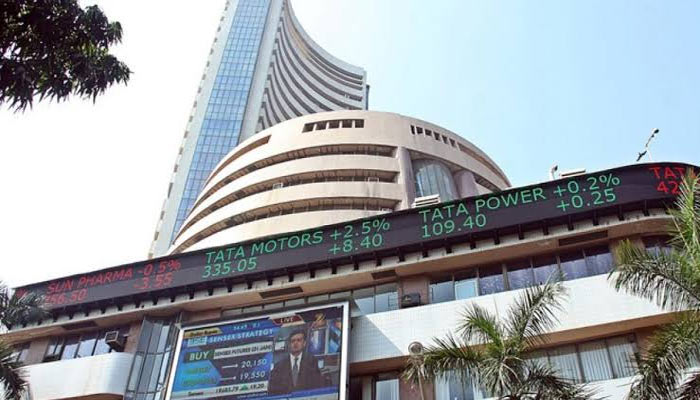
Indian benchmark indices opened little changed on Thursday as losses in information technology stocks offset support from declining crude oil prices, following the recent US-Iran peace agreement.
The BSE Sensex slipped 47 points to 77,108.62 in early trade, while the NSE Nifty50 remained above the 24,000 mark at 24,087.75. The subdued start came after a strong four-session rally during which the Sensex gained 4.5% and the Nifty advanced 4%, driven by easing geopolitical tensions and a sharp decline in oil prices.
The IT sector emerged as the biggest drag on the market after the US Federal Reserve kept interest rates unchanged but signalled a possibility of tighter monetary policy later this year. The Nifty IT index fell 1.58%, making it the worst-performing sector in morning trade.
Among the major laggards were Infosys, which dropped 2.40%, Tech Mahindra, down 1.58%, HCLTech, which fell 1.46%, and TCS, which declined 1.33%.
Higher interest rates in the United States could dampen spending by global clients and weigh on demand for Indian IT services companies, many of which generate a significant share of their revenue from the US market.
Dr V K Vijayakumar, Chief Investment Strategist at Geojit Investments Limited, said investors were reacting to the Federal Reserve’s unexpectedly hawkish tone.
“The market did not anticipate such a hawkish message. The latest projections suggest the possibility of a rate hike later this year. Rising US bond yields have also impacted investor sentiment globally,” he said.
Despite pressure on technology stocks, falling crude oil prices continued to support the broader market. Brent crude slipped to around $78 per barrel, while WTI crude traded near $75, extending recent declines after the easing of tensions in the Middle East and the reopening of shipping routes through the Strait of Hormuz.
Lower oil prices are generally positive for India as they help contain inflation, improve the current account balance and support currency stability.
According to Vijayakumar, these factors could help Indian equities remain resilient despite global uncertainties.
“Crude oil around the $78 mark and stability in the rupee are favourable for the market. Foreign institutional investor selling has moderated, and FIIs turned net buyers in the previous session, though in small quantities,” he said.
Several sectors traded in positive territory despite weakness in IT. Nifty Pharma and Healthcare gained more than 0.5%, while Realty, Chemicals, FMCG, PSU Banks and Metals also registered modest gains.
Among Sensex stocks, Trent, BEL, HDFC Bank, Larsen & Toubro, Sun Pharma and Adani Ports were among the notable gainers.
The broader market continued to outperform, with the Nifty Smallcap 100 rising 0.52%, while the Midcap indices also posted gains.
Meanwhile, India VIX, often referred to as the market’s fear gauge, declined to 13.04, indicating lower volatility expectations and improving investor confidence.
Going forward, investors are expected to closely monitor signals from the US Federal Reserve, movements in bond yields, foreign investment flows and the progress of the monsoon season. While softer crude oil prices and easing FII outflows provide support, any significant disruption to rainfall patterns could raise concerns over food inflation and rural demand.
Comments are closed.