

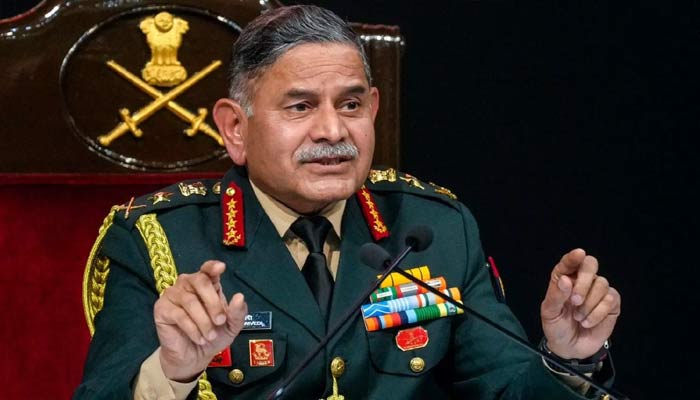
Army Chief General Upendra Dwivedi on Tuesday rejected China’s claim over the Shaksgam Valley, reiterating that the 1963 agreement between Pakistan and China is illegal and unacceptable to India.
Speaking on the issue, Gen Dwivedi said India has never recognised the agreement under which Pakistan ceded territory to China. “On Shaksgam Valley, India considers the 1963 agreement between Pakistan and China illegal. We do not accept it,” the Army Chief said, reaffirming New Delhi’s long-standing position.
His remarks come amid renewed Indian objections to China’s growing infrastructure activity in the Shaksgam Valley, which India maintains is its sovereign territory under illegal occupation.
Earlier, the Ministry of External Affairs (MEA) said Pakistan had illegally ceded about 5,180 square kilometres of Indian territory in the valley to China in 1963. MEA spokesperson Randhir Jaiswal stated that India has “never recognised the so-called China–Pakistan boundary agreement” and considers it illegal and invalid.
Jaiswal also reiterated that India does not recognise the China–Pakistan Economic Corridor (CPEC), which passes through Indian territory under Pakistan’s illegal occupation. He stressed that the Union Territories of Jammu and Kashmir and Ladakh are integral and inalienable parts of India, a position conveyed repeatedly to both Islamabad and Beijing.
India’s concerns have intensified amid reports of large-scale Chinese infrastructure construction in the Shaksgam Valley as part of CPEC. China is reportedly building an all-weather road in the region, with nearly 75 km already completed. New Delhi has warned that such projects risk altering ground realities in an area it considers its sovereign territory.
Responding to these developments, the MEA said India reserves the right to take “necessary measures” to safeguard its interests. China has dismissed India’s objections, claiming its activities in the region are legitimate.
The issue has also underscored what India sees as China’s contradictory stance on Kashmir—publicly describing it as a bilateral matter between India and Pakistan while simultaneously undertaking strategic projects in areas under Pakistan’s illegal occupation.
Why the Shaksgam Valley matters
The Shaksgam Valley, also known as the Trans Karakoram Tract, lies close to the Siachen Glacier in the eastern Karakoram range and borders China’s Xinjiang region and Pakistan-occupied Kashmir. Its proximity to Siachen and access to the Karakoram Pass make it strategically significant, with implications for India’s military posture along both the Line of Actual Control (LAC) and the Line of Control (LoC).
How the territory was ceded
Following the accession of Jammu and Kashmir to India in October 1947, the Shaksgam Valley legally became part of Indian territory. In 1963, Pakistan—under President Ayub Khan—signed a boundary agreement with China, ceding the valley despite India’s formal objections. Since then, China has steadily expanded its presence in the region, making it a growing security concern for New Delhi.
Comments are closed.