

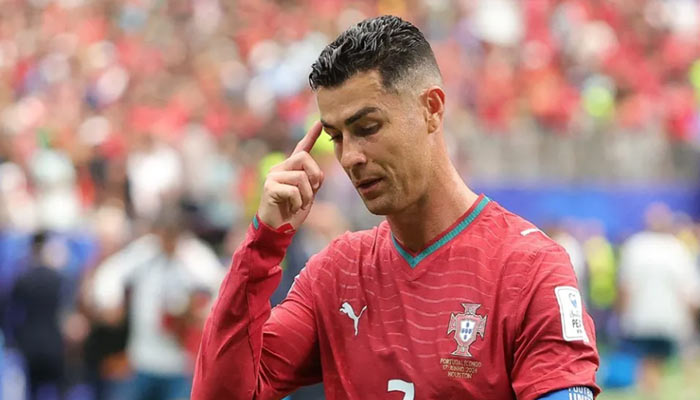
Cristiano Ronaldo stood frozen.
For a few seconds, he simply stared at the scoreboard. Portugal 0, Spain 1.
Around him, Spanish players sprinted towards one another in celebration after booking their place in the FIFA World Cup quarter-finals. For Ronaldo, there was only silence. No seventh World Cup. No final chance to lift the one trophy that had eluded him throughout an extraordinary career.
Only then did the tears arrive.
Portugal’s campaign ended in the cruellest fashion as Mikel Merino’s stoppage-time strike secured a dramatic victory for Spain, bringing what is almost certainly Ronaldo’s final World Cup appearance to a heartbreaking close.
For more than two decades, Ronaldo had carried Portugal through triumphs, disappointments and unforgettable nights. But football rarely guarantees fairy-tale endings. There was no decisive goal, no final act of brilliance, no storybook farewell. The World Cup remained the one chapter missing from an otherwise unparalleled legacy.
Portugal stood firm before Spain found a way
Spain entered the contest as favourites and quickly established control.
Rodri dictated the tempo from midfield, Pedri linked play with trademark composure, while Dani Olmo constantly searched for spaces between Portugal’s defensive lines. Yet despite Spain’s dominance of possession, clear-cut opportunities were few.
That was largely because Portugal defended superbly.
Diogo Costa once again justified his reputation as one of Europe’s finest goalkeepers with a series of crucial saves, but the platform was provided by Ruben Dias and Renato Veiga. The centre-back pairing delivered arguably their finest performance together, matching Spain’s movement with impeccable positioning, timely interceptions and countless blocks.
Nuno Mendes produced another outstanding display on the left, frustrating teenage sensation Lamine Yamal for much of the evening. Every time Spain looked to isolate Yamal in one-on-one situations, Mendes responded with pace, anticipation and immaculate timing.
For more than 90 minutes, Portugal’s defensive structure refused to crack.
Ronaldo still fought until the very end
Ronaldo may no longer possess the blistering acceleration that once terrified defenders across Europe, but his desire has never faded.
He constantly dropped deep to receive possession, battled Spain’s defenders, linked attacks and tried to drag Portugal up the field whenever opportunities arose.
There were reminders of the striker he once was.
A trademark stepover created space for a powerful effort that forced Unai Simon into action. Later, Pedro Neto’s inviting cross flashed inches beyond Ronaldo, who arrived a fraction too late to apply the finishing touch.
The issue wasn’t Ronaldo’s commitment.
It was that Portugal still looked towards him whenever they needed inspiration.
As the second half wore on, the captain repeatedly collected possession near the halfway line, only to discover Spain already settled behind the ball. Too often he found himself searching for runners who never arrived.
Even at 41, Portugal’s first instinct remained to ask Ronaldo to solve problems.
One moment decided everything
Portugal’s resistance finally ended deep into stoppage time.
A quickly taken free-kick caught Martinez’s side before they had fully reset. Fabian Ruiz threaded an intelligent pass into Ferran Torres, whose first-time lay-off pierced Portugal’s defensive line.
Merino timed his run perfectly.
For the first time all evening, the space between Dias and Veiga appeared, and the Spanish midfielder calmly slotted beyond Costa to spark wild celebrations.
After more than 90 minutes of discipline, Portugal had been undone by a single lapse.
A painful ending—and difficult questions
The final whistle left Ronaldo visibly devastated.
Throughout the second half, frustration had been building. He repeatedly gestured for quicker passing, dropped deeper to collect possession and attempted to accelerate attacks himself.
It also highlighted a broader issue for Portugal.
Martinez never introduced Goncalo Ramos, arguably the squad’s most natural centre-forward, despite his side struggling to stretch Spain’s defence during the closing stages. Ronaldo completed the full match while Portugal’s attacking ideas gradually disappeared.
It was another tactical decision that is likely to intensify scrutiny of Martinez’s tenure.
Portugal possess one of Europe’s deepest talent pools, boasting Bruno Fernandes, Bernardo Silva, Vitinha, Rafael Leao, Goncalo Ramos, Nuno Mendes and Diogo Costa. Yet throughout this World Cup they often appeared cautious instead of fearless, organised instead of inventive.
That may become the defining debate after their elimination.
The end of one chapter, the beginning of another
When the emotion settled, Ronaldo’s legacy remained untouched.
He leaves as Portugal’s greatest footballer—the highest goalscorer in men’s international football, the most-capped men’s player in history, the captain who delivered Euro 2016 and two UEFA Nations League titles, and the man who transformed Portuguese football forever.
The World Cup trophy will forever be the only major honour missing from his collection.
Yet Portugal also leave this tournament with optimism.
Diogo Costa reaffirmed his place among the world’s elite goalkeepers. Nuno Mendes looked every bit one of football’s finest full-backs before injury cut short his night. Renato Veiga matured before the world’s eyes, while Bruno Fernandes, Vitinha, Rafael Leao and Goncalo Ramos remain the foundations of Portugal’s next generation.
No one will ever replace Cristiano Ronaldo.
That was never the point.
His greatest gift to Portugal was ensuring that one day they would no longer need to.
As he walked away from the World Cup for the final time, tears streaming down his face, one truth became impossible to ignore.
Cristiano Ronaldo gave Portugal everything.
The World Cup simply wasn’t written into his story.
Comments are closed.