

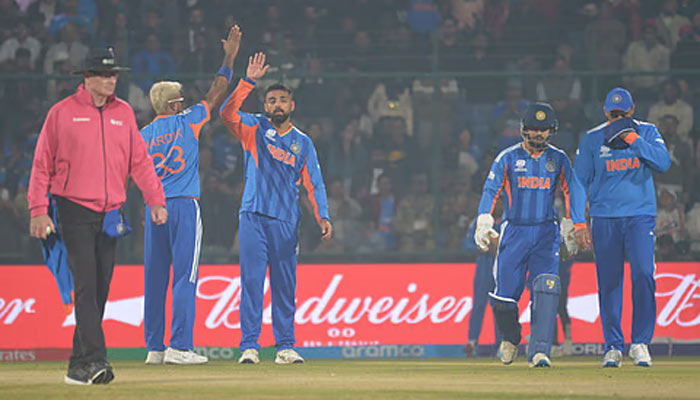
Two matches, two wins, top of the group and a net run rate that reflects dominance. India’s T20 World Cup 2026 campaign, at least statistically, is ticking every box.
But tournament cricket is rarely about what is obvious. With Pakistan looming in Colombo, the focus shifts from results to refinement — and one aspect of India’s game continues to invite scrutiny: their approach against spin.
Winning, But Not Convincing Against Spin
India were comfortable against the USA and Namibia. The margins were healthy, the outcomes never truly in doubt. Yet on both occasions, spin slowed them down. At the Wankhede Stadium, on the most responsive surface for slow bowlers so far, India’s middle order had to grind. In Delhi, Namibia’s spinners accounted for five wickets. Even the USA found breakthroughs through spin.
Namibia captain Gerhard Erasmus did not produce magic deliveries; instead, he applied discipline. Subtle changes of pace, intelligent fields and forcing India to hit against the turn disrupted rhythm. Too frequently, batters looked to muscle the ball straight, rather than manipulating angles or accessing square boundaries.
The wins masked the issue. A stronger spin unit may not.
What the Numbers Say
The raw data offers balance. Since 2025, Hardik Pandya, Shivam Dube, Suryakumar Yadav and Ishan Kishan have maintained strike rates comfortably in the 140–150 range against spin. That suggests India possess the firepower. However, the tempo drops for Tilak Varma and Sanju Samson, both operating in the 120–130 bracket against slow bowling. In a high-pressure contest, that dip can alter momentum, particularly in the middle overs where matches are often shaped.
Former opener Aakash Chopra highlighted the concern, noting that improvement in finishing against spin could prove decisive later in the tournament.
Tactical Adjustments Required
Dinesh Karthik approached the issue from a technical standpoint. He suggested India’s batters could improve by getting into stronger positions to access areas behind square and by using the crease more effectively. The sweeps, laps and reverse options exist within this batting group’s repertoire. The issue is not capability — it is clarity of execution. On turning surfaces, relying solely on straight hitting narrows scoring avenues and increases risk.
Against modest attacks, India recovered. Against Pakistan, such phases may prove costly.
Colombo and the Spin Threat
Pakistan arrive with depth in slow bowling. Abrar Ahmad offers mystery and control. Shadab Khan and Mohammad Nawaz provide balance and experience. Saim Ayub can contribute part-time overs. On a Colombo surface expected to grip, that combination becomes even more potent.
India–Pakistan contests are defined by fine margins. Tactical hesitation can quickly snowball into scoreboard pressure. India remain favourites on paper — deeper, more explosive, and battle-tested in global tournaments. But successful title defences demand proactive correction, not reactive adjustment.
The warning signs are subtle, not alarming. Yet in a fixture of this magnitude, subtle weaknesses are rarely left unexamined. Before Pakistan test them in Colombo, India must demonstrate that their victories are not merely comfortable — but complete.
Comments are closed.