
T20 World Cup: Series-winning Pakistan face Australia with no room for complacency

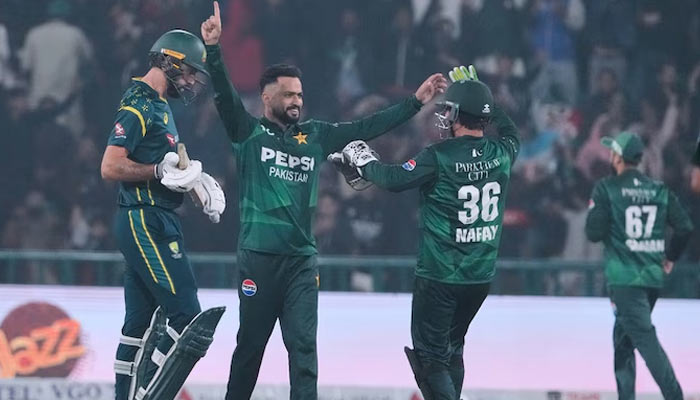
Pakistan handed Australia a brutal end to their T20 World Cup warm-up, inflicting the heaviest T20I defeat of Mitchell Marsh’s tenure and completing a 3–0 sweep that looked emphatic on the scoreboard and explosive in the stands.
The reaction said it all. Full houses, fans celebrating as if a trophy had already been secured, Prime Minister Shehbaz Sharif tweeting in delight, and PCB chairman Mohsin Naqvi entering the dressing room to congratulate the players. A whitewash just days before a World Cup was always going to feel bigger than a routine bilateral series.
And for Pakistan, it did feel like a statement.
But once the emotion settles, the series reveals as much about Australia’s preparation strategy as it does about Pakistan’s momentum.
Australia were convincingly beaten, yet the circumstances were far from ideal. They lost all three tosses, batted second every time and struggled against Pakistan’s spinners while chasing. The collapses were real, but so was the context. This was a tour shaped by rotation, caution and workload management, not desperation for results.
Australia travelled with a deliberately understrength squad. Glenn Maxwell, Tim David, Josh Hazlewood and Nathan Ellis were rested to manage fitness ahead of the Sri Lanka leg of the World Cup. Marsh, Travis Head and Xavier Bartlett played only two matches, while Josh Inglis, Marcus Stoinis and Ben Dwarshuis featured once. Winning the series was secondary to arriving at the tournament intact.
Pakistan, by contrast, were all-in. Their spinners squeezed the middle overs, their batters played with freedom, and confidence surged with each Australian collapse. The series was framed as proof of progress—and on execution alone, it was.
Still, history urges caution when reading too much into Australia’s pre-tournament losses.
At the 2024 T20 World Cup, Australia exited at the Super Eights stage after defeats to Afghanistan and India, a campaign that underwhelmed. Two years on, the focus is not reinvention but correction. Much of the core remains intact. Pat Cummins is the notable absentee due to a back injury, while Mitchell Starc’s retirement from T20Is has reshaped the pace attack, not weakened it.
More importantly, Australia losing just before major tournaments has become familiar. From the 2007 ODI World Cup to the 2021 T20 World Cup, and again ahead of the 2023 World Test Championship final and ODI World Cup, pre-event defeats have often preceded silverware. For Australia, warm-up struggles have rarely been a red flag.
That is why they will still begin the 2026 T20 World Cup among the favourites.
Since the last edition, Australia have won 17 of their 24 completed T20Is, a record that stood at 17 wins from 21 before the Lahore losses with a depleted squad. Their depth of all-rounders remains their defining strength—something former captain Ricky Ponting has consistently highlighted.
The Pakistan series also served a practical purpose. It offered Australia time in subcontinental conditions ahead of Sri Lanka. Cameron Green was trialled at No.3 and is expected to continue there, while Marsh and Travis Head remain the aggressive opening pair.
A familiar senior core is now supported by Green, Inglis and Ellis as regulars. With Cummins unavailable and Starc gone from the format, new pace options are emerging, with Xavier Bartlett set for his first World Cup. Spin depth has also improved, with Adam Zampa, Glenn Maxwell, and left-arm options Matthew Kuhnemann and Cooper Connolly providing variety.
Pakistan may rightly celebrate a dominant sweep. Momentum matters, confidence matters, and this series delivered both. But when it comes to Australia, experience suggests that results just before a World Cup rarely tell the full story.
Comments are closed.