

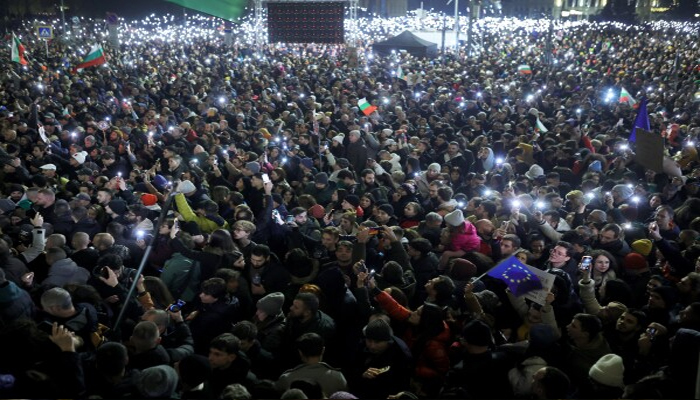
Tens of thousands of Bulgarians took to the streets on Wednesday in one of the country’s largest anti-government demonstrations in years.
Accusing the ruling coalition of entrenched corruption and deepening political divisions just weeks before Bulgaria adopts the euro on January 1.
The latest protests follow last week’s mass rallies sparked by the government’s proposed 2026 budget, which called for higher taxes, increased social security contributions and expanded spending. Although the plan was withdrawn, public anger has since broadened into calls for Prime Minister Rosen Zhelyazkov’s center-right government to resign.
In Sofia, huge crowds filled the central square that houses the parliament, government and presidency buildings, chanting “Resignation” and “Mafia.” Organizers said turnout surpassed last week’s 50,000-strong rallies, while media estimates based on drone footage suggested more than 100,000 people had gathered. Students from major universities also joined the demonstrations.
A key source of public ire is Delyan Peevski, a powerful politician and oligarch whose MRF New Beginning party supports the government. Peevski, sanctioned by both the United States and the United Kingdom, has long been accused by critics of steering government policy to protect oligarchic interests.
The demonstrations ended peacefully, with no violence reported.
Meanwhile, the opposition alliance We Continue the Change – Democratic Bulgaria filed yet another no-confidence motion against the government — its sixth attempt. Lawmakers are set to vote on Thursday.
President Rumen Radev, a vocal critic of the government, said the protests amounted to a public “vote of no confidence,” urging parliamentarians to “listen to the people” ahead of the vote.
Bulgaria, a nation of 6.4 million, is preparing to become the 21st member of the eurozone, replacing its national currency, the lev, with the euro at the start of the new year.
If you’d like it shorter, more headline-driven, or more analytical, I can refine it.
Comments are closed.