

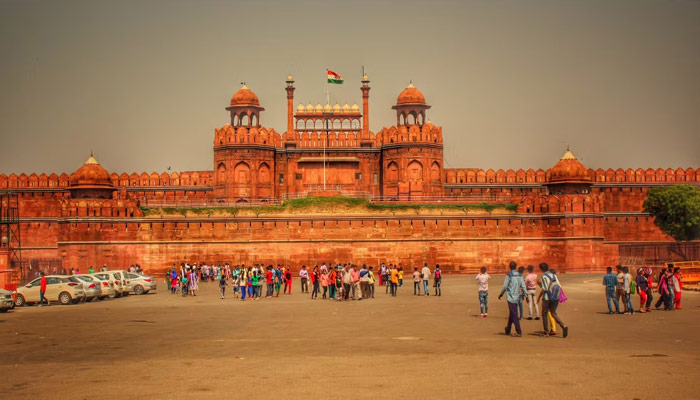
India is home to 44 UNESCO World Heritage Sites, spanning ancient monuments, historic cities, and ecologically rich landscapes. Each site offers a window into the country’s architectural brilliance, cultural diversity, and environmental heritage.
Taj Mahal, Uttar Pradesh (1983)
India’s most celebrated monument, the Taj Mahal captivates with its perfect symmetry, intricate pietra dura inlay, and luminous white marble that changes hues with the light.
Agra Fort, Uttar Pradesh
A 16th-century Mughal stronghold, Agra Fort showcases the evolution of palace architecture. Successive emperors expanded its fortified complexes, leaving behind layers of imperial history.
Ajanta Caves, Maharashtra
Nestled in a horseshoe-shaped gorge, Ajanta’s rock-cut caves contain some of the world’s earliest and best-preserved Buddhist paintings, many dating back nearly 2,000 years.
Ellora Caves, Maharashtra
Known for its seamless blend of Buddhist, Hindu, and Jain monuments carved into a single cliff, Ellora’s highlight is the massive Kailasa Temple—excavated top-down from a monolithic rock.
Elephanta Caves, Maharashtra
Located off the Mumbai coast, the Elephanta Caves are famed for their imposing sculptures of Shiva and intricately carved chambers that reflect early rock-cut craftsmanship.
Sun Temple, Konark (Odisha)
Designed as a colossal stone chariot dedicated to the Sun God, the 13th-century Konark Temple features exquisitely carved wheels, horses, and reliefs showcasing the height of Odishan art.
Group of Monuments at Mahabalipuram, Tamil Nadu
These Pallava-era structures—from monolithic rathas to the iconic Shore Temple—highlight early Dravidian architecture and the maritime legacy of the Coromandel Coast.
Churches and Convents of Goa
A legacy of four centuries of Portuguese rule, Goa’s churches reflect European styles adapted seamlessly to local materials and conditions, marking a major chapter in Christian architecture in India.
Fatehpur Sikri, Uttar Pradesh
Built by Emperor Akbar, this short-lived Mughal capital is a stunning ensemble of red sandstone palaces and courts, blending Persian, Islamic, and Indian design traditions.
Hampi, Karnataka
Spread across a boulder-strewn landscape, Hampi’s ruins evoke the lost grandeur of the Vijayanagara Empire, with remnants of temples, bazaars, royal structures, and water systems.
Khajuraho Group of Monuments, Madhya Pradesh
These temples, celebrated for their refined stone carvings, represent the pinnacle of Nagara-style architecture and depict diverse themes—from spiritual motifs to detailed human expressions.
Group of Monuments at Pattadakal, Karnataka
A UNESCO site where northern and southern temple styles converge, Pattadakal served as a ceremonial centre for the Chalukya dynasty’s architectural innovations.
Humayun’s Tomb, Delhi
This grand garden-tomb introduced Persian charbagh design to India and later inspired Mughal mausoleum architecture, including the Taj Mahal.
Qutb Minar and Its Monuments, Delhi
Home to the world’s tallest brick minaret, this complex marks the beginnings of Indo-Islamic architecture and the early Delhi Sultanate.
Red Fort Complex, Delhi
Commissioned by Shah Jahan, the Red Fort symbolised Mughal power and remains central to India’s national identity, with major political events still unfolding at its ramparts.
Dholavira, Gujarat
One of the most well-preserved Indus Valley civilisation sites, Dholavira stands out for its advanced town planning, water reservoirs, and unique Harappan inscriptions.
Kaziranga National Park, Assam
A global stronghold of the one-horned rhinoceros, Kaziranga’s floodplains support a thriving ecosystem of big cats, birds, and wetlands.
Keoladeo National Park, Rajasthan
Once a royal hunting reserve, this man-made wetland now hosts thousands of migratory birds each winter, making it a world-renowned bird sanctuary.
Manas Wildlife Sanctuary, Assam
Situated at the Himalayan foothills, Manas is noted for its biodiversity and protection of rare species such as the pygmy hog, golden langur, and Bengal florican.
Sundarbans National Park, West Bengal
Part of the world’s largest mangrove forest, the Sundarbans is home to the Royal Bengal Tiger and features a fragile yet vibrant coastal ecosystem.
Comments are closed.