

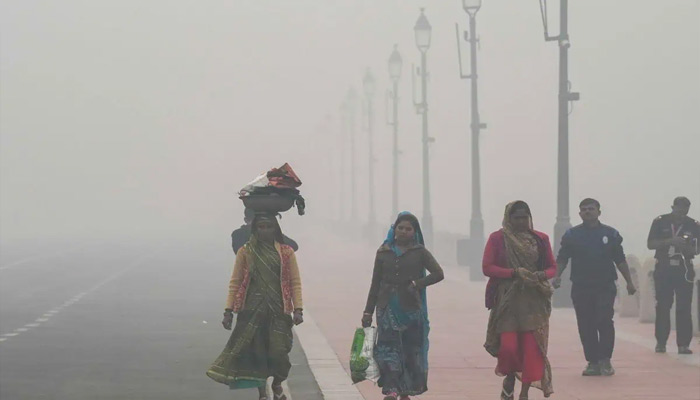
Delhi Chokes as Air Quality Turns ‘Severe’; Govt Alters Office Timings to Ease Traffic Emissions.
Delhi’s air quality deteriorated sharply on Saturday, with several areas recording an Air Quality Index (AQI) above 400, placing the national capital in the ‘severe’ category. The thick haze and falling visibility pushed the city into the ‘red zone’, marking one of its worst pollution days this season.
Data from the Central Pollution Control Board (CPCB) showed Delhi’s 24-hour average AQI at 361 at 4 pm, ranking it the second most polluted city in the country. On Friday, the AQI stood at 322. Pollution levels were especially high at Wazirpur (420), Burari (418), Vivek Vihar (411), Nehru Nagar (406), Alipur (404), and ITO (402)—all in the ‘severe’ range.
The NCR region also fared poorly, with Noida (354), Greater Noida (336), and Ghaziabad (339) recording ‘very poor’ air quality.
Stubble Fires, Vehicle Emissions Fuel Pollution Surge
Fine particulate matter PM2.5 and PM10 remained the dominant pollutants on Saturday. According to the Decision Support System (DSS), stubble burning accounted for nearly 30% of Delhi’s pollution, while vehicular emissions contributed around 15%.
Satellite data showed 100 stubble-burning incidents in Punjab, 18 in Haryana, and 164 in Uttar Pradesh on Friday. The Air Quality Early Warning System forecast that Delhi’s AQI will likely remain in the ‘very poor’ category in the coming days, with no significant improvement expected.
Since Diwali, Delhi’s air has swung between ‘poor’ and ‘severe’, underscoring the capital’s annual struggle with winter smog.
Revised Office Hours to Reduce Peak Traffic
Amid the worsening air crisis, Chief Minister Rekha Gupta on Friday announced staggered timings for government offices to reduce rush-hour traffic and curb vehicular emissions. Under the new schedule, Delhi government offices will function from 10 am to 6:30 pm, while MCD offices will operate from 8:30 am to 5 pm. The arrangement will stay in place until February 15, 2026, coinciding with the peak pollution months.
The Public Works Department (PWD) will also deploy 200 truck-mounted anti-smog guns across the city between October 2025 and February 2026 at a cost of ₹58.8 crore. Each gun will spray fine mist twice daily to help settle dust. Additionally, all buildings taller than G+5 floors must install anti-smog guns.
Comments are closed.