

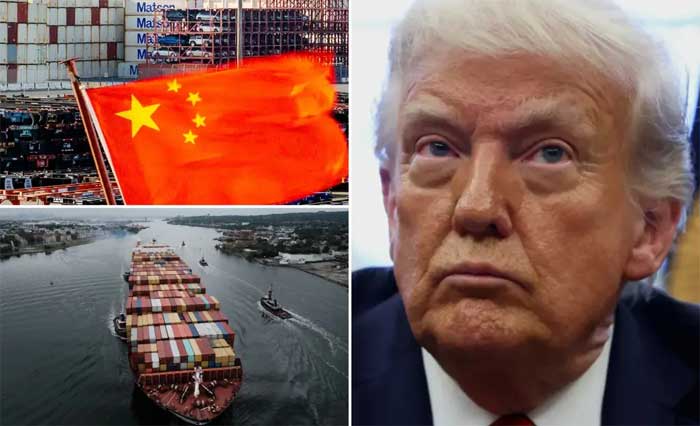
The administration of Donald Trump on Friday released a sweeping strategy to rebuild US shipbuilding and the broader maritime sector, funded in part through port fees on cargo carried by Chinese-built vessels — levies Washington and China have agreed to pause for one year.
The more than 30-page Maritime Action Plan outlines a roadmap to revitalise an industry that has steadily declined since World War II and now trails global competitors, particularly China. The proposal calls for creating “maritime prosperity zones” to attract investment, overhauling workforce training and education, expanding the fleet of US-built and US-flagged commercial ships, establishing a dedicated Maritime Security Trust Fund, and reducing regulatory barriers.
The policy builds on measures first announced early last year, when the Trump administration introduced Section 301 penalties targeting China-linked ships. Those actions followed a US investigation that concluded China employed unfair policies and practices to dominate global shipping and shipbuilding.
The fees, which took effect on October 14, triggered strong opposition from the international shipping industry and heightened tensions between the world’s two largest economies. Officials had projected the levies would generate roughly $3.2 billion annually from Chinese-built vessels calling at US ports.
Beijing responded with retaliatory port charges on US-linked ships, setting off a tit-for-tat cycle that disrupted global shipping flows. The two sides later agreed to suspend the measures for 12 months to ease trade frictions.
Industry stakeholders and lawmakers reacted positively to the newly released maritime strategy, despite its delayed rollout. Shipyard owners, investors, and bipartisan backers of the Shipbuilding and Harbor Infrastructure for Prosperity and Security (SHIPS) for America Act welcomed the plan’s emphasis on long-term funding and industrial renewal.
US Senator Todd Young, a Republican, highlighted significant overlap between the administration’s vision and the SHIPS Act, which he reintroduced alongside Democratic Senator Mark Kelly and other lawmakers.
A central feature of the proposed legislation is the creation of a Maritime Security Trust Fund designed to reinvest port fee revenues into shipyard modernisation, maritime security, and infrastructure upgrades. While the bill has drawn rare bipartisan support in Washington, it has yet to advance quickly through Congress.
“The announcement today should serve as a wake-up call for Congress to act quickly on this bill in order to provide the legal authorities and resources necessary to make this plan a reality,” Young said. “It’s time to make American ships again.”
Comments are closed.