

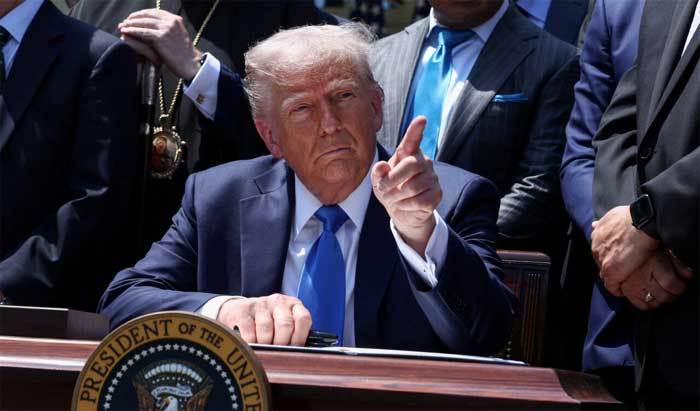
Former President Donald Trump’s latest post warning that “a whole civilisation will end tonight” if Iran does not reach a deal has reignited fears of a nuclear confrontation. The warning came shortly after the US military conducted an attack on Kharg Island, a critical Iranian oil hub, just hours before Trump’s self-imposed deadline to strike a deal with Tehran.
On Tuesday, Trump wrote on Truth Social, “A whole civilisation will die tonight, never to be brought back again. I don’t want that to happen, but it probably will.” Earlier, he had claimed that “the entire country could be taken out in one night,” fueling speculation that he was hinting at the use of nuclear weapons.
Did JD Vance Hint at Nuclear Use?
US Vice President JD Vance appeared to double down on Trump’s warning during a press conference in Budapest on Tuesday evening. Vance stated that the US was hopeful for a response from Iran before Trump’s deadline and cautioned that if Iran did not make the “right decision,” Trump could deploy “tools” that have not yet been used.
“They’ve got to know we’ve got tools in our toolkit that we so far haven’t decided to use. The president of the United States can decide to use them, and he will decide to use them if the Iranians don’t change their course of conduct,” Vance said.
His remarks, along with Trump’s posts, sparked a social media frenzy suggesting a potential nuclear strike, prompting the White House to clarify the statement.
Can the US President Order a Nuclear Strike?
Under the US system, the President holds sole authority to order a nuclear attack. The process typically involves a secure call with the National Military Command Center, where senior officials such as the defence secretary and top military commanders may participate, depending on availability.
A military aide nearby would then open the so-called “nuclear football,” a briefcase containing strike options and authentication codes needed to verify the President’s authority.
The only practical limitation is that individuals within the chain of command could refuse to carry out an order if they judge it to be unlawful, though such a scenario is rare.
The combination of Trump’s warnings, Vance’s comments, and the military action at Kharg Island has once again raised tensions and fears of a potential escalation in US-Iran relations.
Comments are closed.