
Tu Meri Main Tera review: Kartik, Ananya star in a film as deep as a Pinterest board

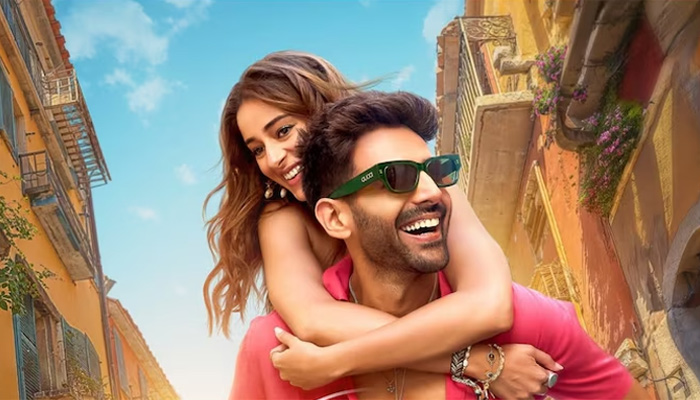
Love is a strange thing. Sometimes it takes years to realise you’ve fallen for the right person. Sometimes, apparently, it takes ten days.
Exactly how long Rumi and Ray need to fall in love in Tu Meri Main Tera Main Tera Tu Meri. Sameer Vidwans’ film leans comfortably into the familiar rich-boy–middle-class-small-town-girl template, whisks its leads off to a foreign location to fast-track romance, introduces a conveniently juvenile conflict, sprinkles some melodrama, and ties it all up with a neat happily-ever-after. Easy for the characters. Less so for the audience.
Indian cinema has been recycling love stories for decades, largely because there’s something timeless about two people stumbling towards each other. And while Tu Meri Main Tera Main Tera Tu Meri looks glossy and stylish on the surface, the storytelling begins to unravel almost immediately. Very little here adds up — not the meet-cute, not the relationship, not the conflict, not even the casting.
The film carries the unmistakable Dharma Productions stamp: glamorous frames, attractive people, plush locations, heightened emotions and a dash of family drama. What it lacks, however, is the one thing the banner has historically excelled at — emotional connect.
Rumi and Ray are Gen-Z characters attempting to manufacture a “90s love story” for themselves. They meet, bump into each other repeatedly, and fall in love at breakneck speed. There’s no friction, no emotional stake, no reason for the audience to care beyond the Pinterest-board aesthetic the film is so enamoured with.
Kartik Aaryan and Ananya Panday look fine individually, but together they generate little to no spark. They manage scenes on their own, but the moment they share the frame, the chemistry fizzles out. The kisses lack heat, the romantic beats feel rigidly choreographed, and the usual rom-com magic — lingering glances, charged silences, effortless intimacy — feels forced rather than felt.
And one can’t help asking: how long will Kartik’s perpetually self-aware, I-am-cute-love-me-because-I’m-an-outsider persona continue to pass off as depth? For how long will the rich-boy-with-a-desi-heart trope be repackaged as emotional complexity? And why do male leads still get a free pass to insult women early on, only to be redeemed by romance and moral posturing?
In a film that eventually becomes as exhausting as its title — both to write and pronounce — Jackie Shroff and Neena Gupta emerge as unlikely anchors. Their performances lend the narrative some rhythm and warmth, and for brief stretches, they offer the audience a reason not to mentally drift towards the exit.
The central conflict is among the most juvenile Bollywood has served up in a love story in recent memory. Ray’s great tragedy is being forced to leave India and settle in the US. His “sacrifice” is framed as emotional devastation. Cue the world’s smallest violin.
The tone-deafness is familiar. It echoes celebrity anecdotes where privilege is repackaged as struggle — overseas education framed as hardship, international holidays as emotional deprivation. Rumi and Ray’s problems belong squarely in this category: privileged inconveniences masquerading as adversity.
Layered over this flimsy conflict is meta humour — the industry’s current shortcut to sounding clever. Ray casually references nepotism and outsider status, with one line landing almost too on the nose: “Bahot gandi acting kar raha hoon main yahan, ab ye practical baat bol ke meri acting aur mat bigado.”
The dialogue tries hard to sound woke and ends up sounding silly. Lines land awkwardly, product placements are painfully obvious, and jokes about “faltu feminism”, AI writers, and ChatGPT overstaying their welcome quickly fall flat. At some point, you realise everyday group chats are funnier than what the film is attempting.
Tu Meri Main Tera Main Tera Tu Meri could have been a breezy romantic film that genuinely spoke to a younger audience. Instead, it strains to look glossy and global while repeatedly insisting it is desi at heart. It mistakes aesthetic for emotion and assumes picturesque locations and attractive faces are enough to sustain interest.
Its half-baked feminism, paired with an equally clumsy critique of “pseudo feminism”, only adds to the confusion. There are loopholes everywhere, but the biggest flaw is unavoidable: the film never earns an emotional connection.
It feels like a beautifully wrapped Christmas present that turns out to contain a packet of Maggi. Not terrible — just deeply underwhelming. And when the credits roll, you’re left wondering what, exactly, you were meant to feel.
Comments are closed.