
UAE, Qatar war news LIVE: Fresh blasts heard in Dubai; UAE says intercepting missiles from Iran

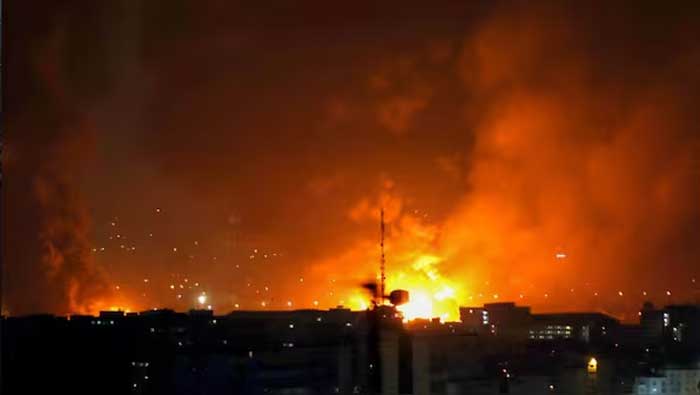
The United Arab Emirates on Saturday confirmed it was responding to incoming missile and drone threats from Iran, as tensions from the ongoing regional conflict spilled across the Gulf.
In a post on X, the UAE Ministry of Defence said the loud sounds heard across the country were the result of air defence systems intercepting missiles and drones. Explosions were also reported in Dubai.
Sirens were also activated in Bahrain, where AFP reported at least five loud explosions in the capital Manama.
Earlier on Saturday, a fresh missile threat was reported in Dubai while loud bangs were heard in Abu Dhabi, as the conflict between the United States and Iran continued to impact the wider Middle East. Authorities also reported a “minor” incident in Dubai, saying debris fell after a missile was intercepted.
Even as airlines gradually resumed flights to the region, some aircraft were seen circling above Dubai International Airport and delays were reported.
A day earlier, residents in Dubai and Qatar received mobile alerts warning of a possible missile threat. Later, Qatar authorities said the security threat had been eliminated.
UAE president’s first comments since war
In his first public remarks since Iran launched missile strikes across the Gulf, Mohammed bin Zayed Al Nahyan, president of the United Arab Emirates and ruler of Abu Dhabi, said the country was not an easy target and would emerge stronger from the conflict.
Speaking to Abu Dhabi TV in a rare address on Saturday, he said the UAE was currently “in a period of war” but would come out of the crisis stronger.
Air defence intercepts missiles and drones
According to the defence ministry, UAE air defence systems detected 16 ballistic missiles on March 7, of which 15 were intercepted while one fell into the sea.
They also detected 121 unmanned aerial vehicles, with 119 intercepted and two falling inside UAE territory.
Since the start of the Iranian attacks, the UAE has detected 221 ballistic missiles — 205 were destroyed, 14 fell into the sea and two landed within the country, the ministry said. Eight cruise missiles were also detected and shot down.
The attacks resulted in three deaths — nationals of Pakistan, Nepal and Bangladesh — while 112 people of multiple nationalities sustained minor injuries.
India advisory for tourists in Qatar
Amid the escalating situation, the Embassy of India in Qatar issued an advisory for tourists holding the Hayya A1 visa, asking them to fill out a form to help authorities track stranded citizens.
“Please note that this is only for the purpose of ascertaining the exact number and details of stranded Indian nationals who are not residents of Qatar,” the advisory said.
Security alerts and evacuation plans
Residents in Dubai received a security alert on their phones warning of “potential missile threats” and urging them to seek shelter in secure buildings and stay away from windows, doors and open areas, according to AFP. A similar alert was later issued in Qatar.
As the conflict raises concerns for expatriates in the Gulf, several countries — including Poland, France, Hungary, Italy, Germany, Bulgaria and Netherlands — have begun arranging evacuation flights for their nationals.
The India government also said domestic airlines would operate 96 flights to evacuate citizens from the United Arab Emirates, Qatar, Saudi Arabia and other parts of West Asia.
Comments are closed.