

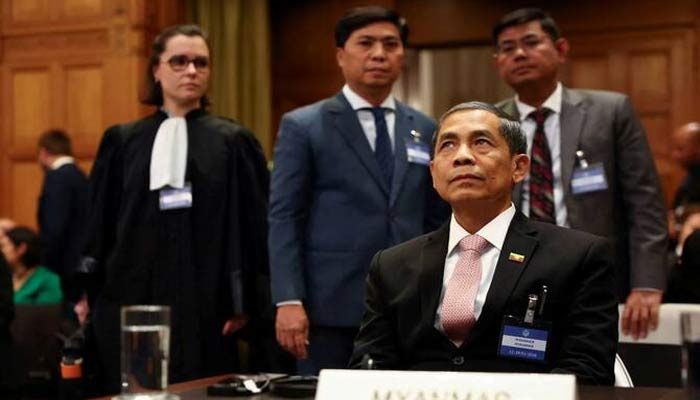
The International Court of Justice (ICJ) on Monday opened hearings in a landmark case accusing Myanmar of genocide against its mostly Muslim Rohingya minority, marking the first genocide case to come before the UN’s top court in more than a decade.
The case was brought by The Gambia in 2019, two years after a military crackdown in Myanmar’s Rakhine state forced hundreds of thousands of Rohingya to flee to neighbouring Bangladesh. The hearings are scheduled to run for three weeks, ending on January 29.
The Rohingya, a predominantly Muslim ethnic minority, have lived for generations in western Myanmar but were stripped of citizenship in the 1980s and have since faced sustained discrimination and persecution. In 2017 alone, around 750,000 Rohingya crossed into Bangladesh following a military operation that the United Nations later described as a “textbook case of ethnic cleansing.” Today, about 1.3 million Rohingya live in 33 refugee camps in Bangladesh’s Cox’s Bazar district, the world’s largest refugee settlement.
“We experienced arson, killings and rape in 2017 and were forced to flee,” said Asma Begum, a Rohingya refugee who has lived in the Kutupalong camp since 2017. “The ICJ must deliver justice for the Rohingya. Justice delayed is justice denied.” A UN fact-finding mission has concluded that Myanmar’s 2017 military campaign involved “genocidal acts,” a charge Myanmar rejects, maintaining that the operation targeted militants.
The opening of the case has renewed hopes among refugees that accountability could eventually lead to safe and dignified repatriation. “We have the right to return to our ancestral land and live with dignity,” said Syed Ahmed, who fled Myanmar in 2017 and has since raised his four children in the Kutupalong camp. He said he remained hopeful that the ICJ verdict would hold perpetrators accountable and set an important precedent.
Legal observers say the outcome of the Myanmar case could influence how the ICJ approaches other genocide-related cases currently before the court. “The momentum of this case sends a strong signal that crimes against humanity cannot be ignored,” said Nur Khan, a Bangladeshi lawyer and human rights activist. “It reinforces the ICJ’s role in addressing allegations of genocide globally.”
Comments are closed.