
Unrest Intensifies in Bangladesh Ahead of Hasina’s Return; Yunus’s Ancestral House Attacked in Chattogram

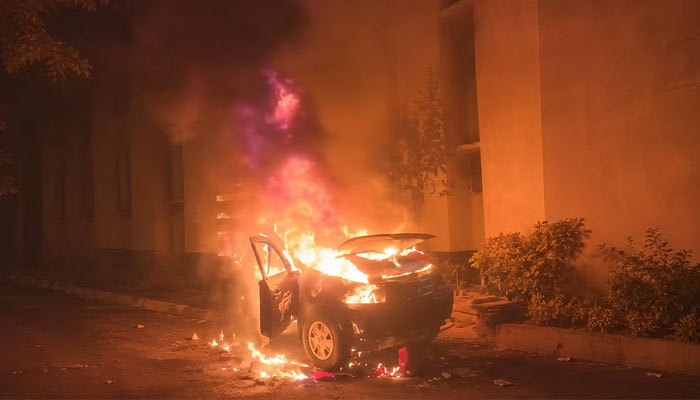
Bangladesh on Edge as Arson, Bomb Blasts Sweep Country Ahead of Sheikh Hasina’s Expected Return
Bangladesh is witnessing a fresh outbreak of violence, with several districts reporting bomb explosions, arson attacks and clashes as political tensions mount ahead of former Prime Minister Sheikh Hasina’s expected return next month. Members of her Awami League party have also reportedly faced attacks.
Gopalganj, Hasina’s hometown, has emerged as one of the centres of unrest. A video circulating on social media purportedly shows a police station and several vehicles being torched amid tensions involving her supporters. Hasina has been staying in India since leaving Bangladesh.
The violence has also reached Chattogram, where unidentified attackers reportedly set fire to the ancestral residence of Professor Muhammad Yunus, who served as chief adviser to the former interim government. According to The Daily Star, the incident occurred on Wednesday night in the city’s Panchlaish area.
28 districts report bomb blasts, arson
The latest incidents are part of a broader spell of unrest involving crude-bomb attacks, vehicle fires, damage to public facilities and street demonstrations.
According to local media reports, at least 28 districts have witnessed explosions or arson incidents over the past 10 days. The violence has reportedly caused deaths, injuries and widespread damage to property.
In Dhaka, two crude bombs exploded near Hazrat Shahjalal International Airport on November 16, injuring three pedestrians. Another blast was reported outside the residence of Cultural Affairs Minister Nitai Roy Chowdhury on November 17.
In Gopalganj, a BNP lawmaker’s house was reportedly set on fire. Tungipara Police Station was also targeted, with several police personnel sustaining injuries.
Faridpur and Pirojpur witnessed separate arson attacks on vehicles that claimed the lives of transport workers.
37 Grameen Bank offices targeted
Financial institutions and public transport have also come under attack. Local reports indicate that at least 37 Grameen Bank offices have been targeted in arson attacks or attempted arson since November 10.
Several buses have also been torched at different locations, adding to concerns over the deteriorating security situation.
Garment workers, rickshaw drivers take to streets
Political instability has coincided with growing labour unrest in major industrial areas.
Garment workers in Dhaka, Gazipur, Savar and Ashulia have continued demonstrations demanding an increase in the monthly minimum wage from 12,500 taka to 30,000 taka.
The protests have affected hundreds of factories, disrupted production, blocked major highways and triggered clashes with security personnel.
Battery-operated rickshaw drivers have also launched separate demonstrations, seeking licences and operating permits while demanding an end to the seizure of their vehicles.
Government strengthens security arrangements
The BNP-led government has accused supporters of the banned Awami League of involvement in the recent violence. However, the responsibility for individual attacks remains under investigation.
To contain the unrest, authorities have deployed additional police and paramilitary forces, established security checkpoints and detained dozens of suspects.
The combination of political confrontations, labour disputes and repeated attacks on public infrastructure has placed Bangladesh’s security apparatus under increasing pressure as the country approaches another politically sensitive period.
Comments are closed.