

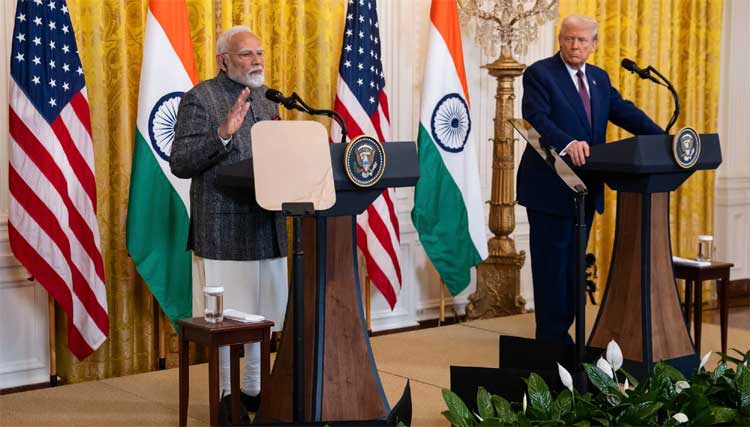
The White House said US trading partners that had secured tariff arrangements under Donald Trump’s administration, including India, would now also face a baseline 10 percent duty, even if they had earlier agreed to higher rates.
The announcement followed a major legal setback for Trump after the Supreme Court of the United States struck down his sweeping global tariffs in a 6–3 ruling. Reacting sharply, Trump criticised some of the justices, saying he was “absolutely ashamed” and accusing them of being “disloyal to our Constitution.”
Soon after the judgment, Trump signed an executive order imposing a 10 percent worldwide tariff on foreign goods. He said the measure would take effect “almost immediately,” later adding on social media that it was a “Global 10% Tariff on all Countries.” A White House fact sheet stated the duties would come into force on February 24 at 12:01 am Washington time.
Why were Trump’s earlier tariffs struck down?
The court ruled that Trump had exceeded presidential authority by using the International Emergency Economic Powers Act (IEEPA) to levy broad import tariffs without congressional approval.
IEEPA has historically been applied to sanctions and asset freezes rather than trade taxes. The Constitution assigns tariff and taxation powers to Congress, not the president. Writing for the majority, Chief Justice John Roberts said such an “extraordinary assertion” of power required clear congressional authorisation, which was absent in this case.
What about the India–US trade framework?
Trump indicated that the revised tariff structure affecting India would remain intact. He said “nothing changes” regarding the planned 18 percent duties tied to the interim trade framework between Washington and New Delhi.
Earlier, the US had eased punitive tariffs on India after both sides agreed on a framework for an interim trade arrangement. As part of that understanding, Washington reduced proposed reciprocal tariffs while highlighting India’s shift away from Russian energy purchases toward American supplies.
New global tariff strategy
Defending the fresh move, US Treasury Secretary Scott Bessent said the new baseline tariffs — along with potential measures under Section 301 (unfair trade practices) and Section 232 (national security) — were expected to result in little overall change in tariff revenue projections for 2026.
The administration framed the 10 percent duty as a stabilising mechanism following the court’s decision, ensuring continuity in US trade policy.
Comments are closed.