

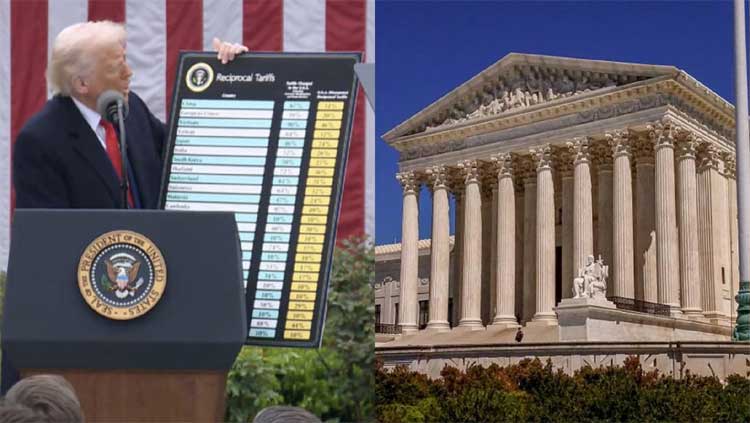
In a major ruling with global trade implications, the United States Supreme Court on Friday struck down most of President Donald Trump’s broad-based tariffs, marking one of the most consequential judicial setbacks of his second term.
In a 6–3 decision, the court held that the 1977 International Emergency Economic Powers Act (IEEPA) does not grant the president authority to impose tariffs. The majority concluded that the emergency powers law cannot be used to justify wide-ranging import duties on goods from nearly all U.S. trading partners.
Chief Justice John Roberts authored the opinion, joined by the three liberal justices and conservatives Neil Gorsuch and Amy Coney Barrett. Justices Samuel Alito, Clarence Thomas, and Brett Kavanaugh dissented.
Do U.S. tariffs on India go to zero?
Not entirely — but the ruling brings substantial changes.
The decision does not affect tariffs imposed under other legal authorities, including duties on steel and aluminum. However, it invalidates tariffs introduced under IEEPA, including the country-specific “reciprocal” tariffs.
India had been subject to these reciprocal tariffs, initially set at 26% and later revised to 25%. With the court’s ruling, those IEEPA-based levies are no longer valid, effectively removing the reciprocal tariffs on most Indian goods.
Separately, the Trump administration had earlier withdrawn 25% “penalty” tariffs linked to India’s imports of Russian oil following progress in bilateral trade talks. With both the penalty and reciprocal tariffs gone, many Indian exports now revert to standard U.S. tariff rates.
Tariffs still apply in some sectors
Sector-specific duties, particularly on steel and aluminum, remain in place as they were imposed under different statutes. As a result, U.S. tariffs on Indian goods do not drop to zero across the board.
Can the administration reimpose tariffs?
The ruling does not prevent the White House from pursuing tariffs under alternative laws. The administration is expected to consider other statutory tools, such as Section 232 (national security) and Section 301 (unfair trade practices), though these mechanisms involve more procedural constraints.
Implications for India
For India, the judgment provides near-term relief for exporters, especially in sectors previously affected by the reciprocal tariffs, including textiles, pharmaceuticals, and engineering goods.
The decision could also trigger efforts by companies to seek refunds for duties paid under the now-invalidated tariff regime, though the financial impact remains unclear.
While the ruling limits the use of emergency powers for trade policy, the longer-term trajectory of U.S. tariffs on Indian goods will depend on how the White House and Congress respond.
Comments are closed.