

Winter Spiti: Not Just A Postcard, But A Test Of Endurance
An exhilarating road trip, snow-covered peaks, and skies so clear they almost seem unreal—winter in Spiti sounds like a dream. But is it truly a tourist’s paradise? Does it live up to the glossy perfection of Instagram?
To find out, I set out on a seven-day journey in late February, peak winter in the Himalayas, determined to see whether Spiti is as effortless as it looks—or far more demanding than it appears online.
The journey began with an overnight bus ride from Delhi to Shimla. From there, a minibus carried me and 12 other travellers deeper into the mountains on an eight-hour drive to Chitkul, often called India’s last village.
The route itself was a test of nerves. Part of the Hindustan-Tibet highway in Kinnaur, the road is carved into steep cliffs, with the roaring Sutlej river far below on one side and barely enough space for vehicles to pass on the other. It’s beautiful—but unforgiving.
By the time we reached Chitkul, exhaustion had taken over. Comfort came in simple forms: a hot meal and a warm bed. Running water, however, was a luxury we didn’t have. Instead, we shared drums of ice-cold stored water.
The next day, we resumed our journey toward Spiti, stopping briefly at Khab Sangam and Sangla before finally reaching Tabo after another long, bone-chilling drive. If Kinnaur’s roads were a warning, Spiti’s terrain was the real challenge—more remote, more dangerous, yet hauntingly beautiful.
Our stay in Tabo, at a monastery-turned guesthouse opposite the ancient monastery, offered a rare moment of calm. Under a sky full of stars, surrounded by stark mountains, it became clear what sets Spiti apart: a raw blend of nature, culture, and isolation that few places can match.
But the toughest stretch still lay ahead—Kaza.
After another six-hour drive, we arrived at our final base, where we would spend the next three days. By then, the altitude had begun to take its toll. Oxygen levels dropped, and even basic tasks—walking, washing, or stepping outside—felt exhausting. The cold seeped into everything.
For some first-time travellers, the experience was overwhelming. Doubts crept in: was this the right choice?
Jatin Singh, a trip captain who has led over 75 groups to Spiti, says the beauty is undeniable—but it comes at a cost.
“Spiti looks exactly like what you see online,” he explains. “But you have to work hard to experience it. The altitude, the terrain, the long travel—it’s not easy. People shouldn’t blindly trust Instagram. They need to research properly before coming.”
He adds that winter travel is particularly challenging. The Manali route remains shut due to heavy snowfall, leaving the longer Shimla–Kaza route as the only option. Even then, gradual stops are essential for acclimatisation.
“Your body needs time to adjust. Without that, the risk of falling sick increases,” he says.
Comfort, too, takes a backseat in winter Spiti.
“There are no attached washrooms because water freezes. Most stays are traditional mud houses. Water is stored in drums, bathing is rare, and food is basic—usually dal and rice,” Singh explains.
Medical support is limited. With no private hospitals and naturally low oxygen levels in this cold desert, even minor health issues can escalate.
“We carry oxygen cylinders and first-aid kits, but we’re not doctors. In serious cases, descending to lower altitudes is the only option,” he adds.
And yet, despite the hardships, Spiti delivers moments that make it all worthwhile.
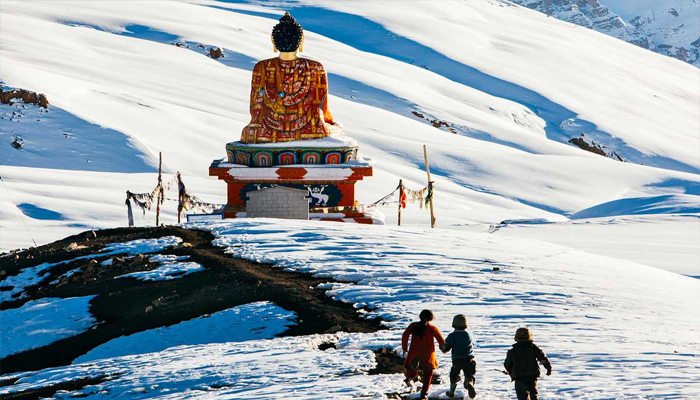
Visits to Key Monastery, Dhankar Monastery, and the towering Buddha statue leave you awestruck. The silence, the scale, and the stark beauty create an experience that no photograph can fully capture.
Evenings, too, bring their own warmth. Around dinner tables, strangers bond over shared struggles, laughter, and games—turning a group of travellers into something closer to a community.
That, perhaps, is the real essence of Spiti.
It may look like a dream on Instagram, but the reality is raw, demanding, and far from comfortable. The cold bites harder, the roads test your limits, and luxuries are almost non-existent.
But for those willing to embrace it, Spiti offers something far deeper than a picture-perfect escape.
It offers perspective.
In the end, Spiti isn’t for tourists seeking comfort—it’s for travellers ready to earn the journey.
Comments are closed.