
World’s First Nuclear-Resistant Floating Island Under Construction in China

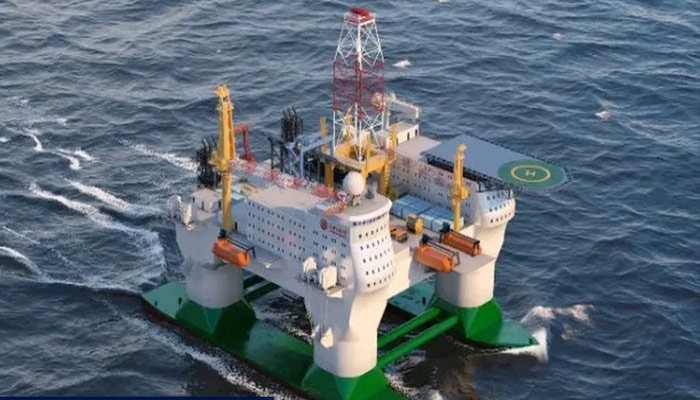
China Building 78,000-Tonne Nuclear-Resistant Floating Island, To Be Ready by 2028.
China is constructing a 78,000-tonne artificial floating island capable of withstanding nuclear blasts, according to reports in Chinese state media. The massive semi-submersible, twin-hull platform—described as the world’s first of its kind—will serve as a long-term deep-sea research base and is expected to be operational by 2028.
Comparable in size to China’s Fujian aircraft carrier, the mobile facility can support 238 personnel for up to four months without resupply. Designed to endure extreme weather, it can withstand 6–9 metre waves and Category 17 typhoons, the highest classification of tropical cyclones.
“We’re racing to complete the design and construction, aiming for operational status by 2028,” said Lin Zhongqin, the academician leading the project, speaking to Economic Information Daily.
According to the South China Morning Post, the structure incorporates advanced metamaterial sandwich panels engineered to absorb powerful shockwaves—transforming “catastrophic shocks into gentle squeezes,” as scientists describe it.
In a technical note, a research team led by Professor Yang Deqing of Shanghai Jiao Tong University (SJTU) said the platform is intended for “all-weather, long-term residency.” Its superstructure contains reinforced compartments for emergency power, communications, and navigation—spaces that require the highest level of nuclear-blast protection.
Officially named the Deep-Sea All-Weather Resident Floating Research Facility, the platform is the result of more than a decade of development. Measuring 138 metres long and 85 metres wide, with a 45-metre-high main deck, the island is part of China’s effort to expand deep-sea capabilities.
Although publicly presented as a civilian scientific project, its design references GJB 1060.1-1991, a Chinese military specification for nuclear-blast resistance—indicating it is built to survive even the most extreme wartime scenarios.
Comments are closed.