

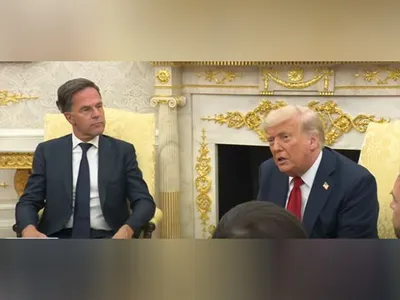
Ukrainian President Volodymyr Zelenskyy expressed gratitude to U.S. President Donald Trump for a new weapons deal facilitated through NATO, describing their conversation as “very good” and emphasizing the importance of their “good relationship.” According to The Tribune and CNN, the agreement, announced during Trump’s meeting with NATO Secretary General Mark Rutte, involves the U.S. supplying advanced weaponry, including Patriot missile systems, to Ukraine via NATO allies who will cover the costs. This development, a significant step in bolstering Ukraine’s defense against Russian aggression, marks a warming in the previously turbulent Zelenskyy-Trump relationship, as highlighted by posts on X celebrating the renewed cooperation.
A Game-Changing Weapons Deal
The weapons deal, unveiled on July 14, 2025, in Washington, D.C., allows the U.S. to sell “top-of-the-line” weapons to NATO countries, which will then transfer them to Ukraine, with European allies footing the bill. Trump, speaking alongside Rutte, confirmed the inclusion of Patriot missile batteries, critical for countering Russia’s intensified drone and missile attacks, which included a record 741 drones and ballistic missiles launched across Ukraine in early July, as reported by The Guardian. CNN noted that Germany, Norway, Finland, Denmark, and Sweden are among the nations potentially supplying or funding the equipment, with Germany committing to two Patriot systems and Norway one, per Zelenskyy’s remarks in Rome on July 10, 2025.
Zelenskyy, in a post on X, thanked Trump for his “willingness to support Ukraine” and highlighted discussions on protecting Ukrainian citizens from Russian attacks. “We discussed the necessary means and solutions with the President to provide better protection for people from Russian attacks and to strengthen our positions,” he wrote, adding that they agreed to “catch up more often by phone” to coordinate future steps. The deal follows a temporary halt in U.S. weapons deliveries in March 2025, amid a review of military spending, which had strained U.S.-Ukraine relations, as reported by CNN. The resumption of aid, coupled with this new NATO arrangement, signals a strategic shift in Trump’s approach, driven by frustration with Russian President Vladimir Putin’s lack of progress toward peace, as noted in BBC News.
Rebuilding a Rocky Relationship
The Zelenskyy-Trump relationship has been marked by volatility, most notably a heated Oval Office meeting in February 2025, where Trump and Vice President JD Vance berated Zelenskyy for being “disrespectful,” derailing a proposed minerals deal, according to CBS News and AP News. Trump’s earlier criticisms, including calling Zelenskyy a “dictator” and blaming him for the war, had fueled tensions. However, recent interactions, including a productive Vatican meeting in April 2025 and the minerals deal signed on April 30, 2025, have softened the dynamic, as reported by The New York Times and CNN. Posts on X reflect this shift, with users like @AllisonAjuluch noting, “A lot has changed since his disastrous White House meeting in February.”
Zelenskyy’s praise for Trump underscores Ukraine’s strategic pivot to align with the U.S. administration’s priorities, including economic partnerships like the minerals deal, which grants the U.S. preferential access to Ukraine’s graphite, lithium, and rare earths. CNN reported that Ukraine secured favorable terms in this agreement, avoiding reimbursement for past aid, a key concession from Trump. This diplomatic maneuvering, combined with the weapons deal, highlights Zelenskyy’s efforts to maintain U.S. support amid ongoing Russian aggression.
Challenges and Global Implications
While the weapons deal is a significant boost, Ukraine faces challenges in countering Russia’s advances, which control roughly a fifth of its territory, per BBC News. Russian officials, including lawmaker Konstantin Kosachev, dismissed Trump’s accompanying threat of 100% secondary tariffs on Russia’s trading partners as “hot air,” suggesting skepticism about its impact. In Ukraine, critics like MP Mariana Bezuhla expressed frustration, claiming Trump’s 50-day ultimatum for a peace deal gives Russia “carte blanche” to escalate, as noted in The Guardian. The deal’s reliance on European funding also raises questions about long-term sustainability, given global supply chain issues with Patriot systems, as highlighted by The Washington Post.
The National Education Policy (NEP) 2020’s focus on international collaboration indirectly supports such multilateral efforts, fostering partnerships that enhance global security. The deal aligns with NATO’s shift toward greater European responsibility for Ukraine’s defense, as emphasized by Rutte, who noted Europe’s “esprit de corps” in supporting the war effort.
Looking Ahead
The NATO weapons deal marks a pivotal moment for Ukraine, enhancing its defense capabilities as Russian attacks intensify. Zelenskyy’s strengthened ties with Trump, evidenced by their agreement to maintain regular contact, suggest a pragmatic approach to securing U.S. support. However, the 50-day deadline for peace talks, coupled with Trump’s tariff threats, adds pressure on Kyiv to negotiate, potentially at the cost of territorial concessions, a prospect Zelenskyy has cautiously acknowledged, per The New York Times. As Ukraine navigates these challenges, the weapons deal offers a lifeline, reinforcing its resilience and the importance of international alliances in countering aggression.
Comments are closed.