

Air Force Pilot Shubhanshu Shukla Becomes First Indian to Enter the International Space Station.
In a historic leap for India’s space ambitions, Air Force Group Captain Shubhanshu Shukla on Thursday became the first Indian to enter the International Space Station (ISS), joining a select league of global astronauts and marking a proud milestone for the country.
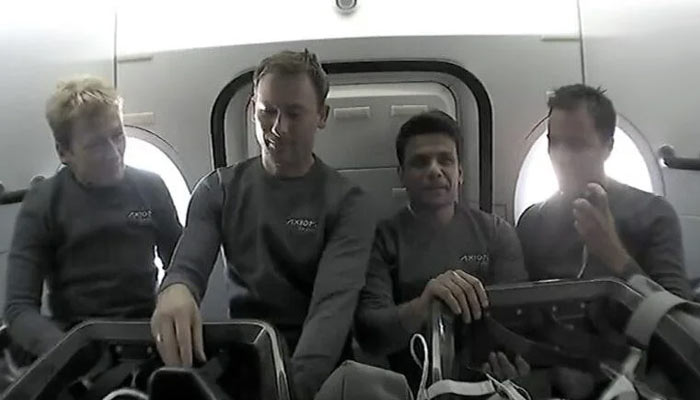
Live footage from the ISS showed Shukla, along with three other astronauts aboard the Crew Dragon capsule, being welcomed aboard with wide smiles and warm hugs by the station’s existing crew. The group later gathered for a lighthearted photo-op, sipping liquids from foil packets—a tradition among new arrivals.
The astronauts are part of Axiom-4, a private space mission. Their spacecraft, named Grace, docked with the ISS after a 28-hour journey from NASA’s Kennedy Space Center in Florida, arriving 424 km above the northern Atlantic Ocean.
A Complex Docking Maneuver
The docking sequence—essential for securely attaching the spacecraft to the ISS—involved a series of precise orbital maneuvers. First came the rendezvous, aligning the spacecraft and the station in the same orbital plane and matching velocity vectors to allow a safe approach.
At 4:01 PM IST, Mission Control confirmed a soft capture, allowing the spacecraft and ISS to gently absorb the impact of initial contact. A few minutes later, a hard capture locked the capsule firmly in place, completing the docking at 4:15 PM IST.
“We are honored to be here… thank you,” said Mission Commander Peggy Whitson during a live stream.
The astronauts won’t immediately float into the ISS. Final safety checks, including pressure equalization and seal integrity, must be completed before the hatch opens—scheduled for 6:10 PM IST.
Launched From History
The mission lifted off at 12:01 PM IST on Wednesday from Launch Complex 39A—the same launch pad that once sent Neil Armstrong and Apollo 11 to the Moon. The launch faced six prior delays, and nearly a seventh, before a last-minute software glitch was resolved just in time.
As the Falcon 9 rocket ignited, its powerful Merlin engines roared to life, pushing the capsule into orbit and starting a journey Shukla later described as “magical.”
“After 30 days of quarantine and all the delays, all I could think was, ‘Let’s just go,’” he said from orbit. “When it happened… it was something else. You’re pushed back into your seat, and then suddenly, there’s silence. You’re floating. It’s magical.”
Two Weeks of Scientific Discovery
Over the next 14 days, the astronauts will carry out 60 experiments, including seven designed by Indian scientists. These include a study on tardigrades (commonly called water bears) to understand how microscopic organisms adapt to microgravity.
Other experiments will focus on bio-manufacturing and bio-astronautics, pushing the boundaries of human health and industrial processes in space.
Shukla expressed deep gratitude for the international team of engineers, scientists, and mission planners who made the flight possible.
“This is a collective achievement,” he said. “I truly appreciate the efforts of everyone involved. This success belongs to all of us.”
Comments are closed.