

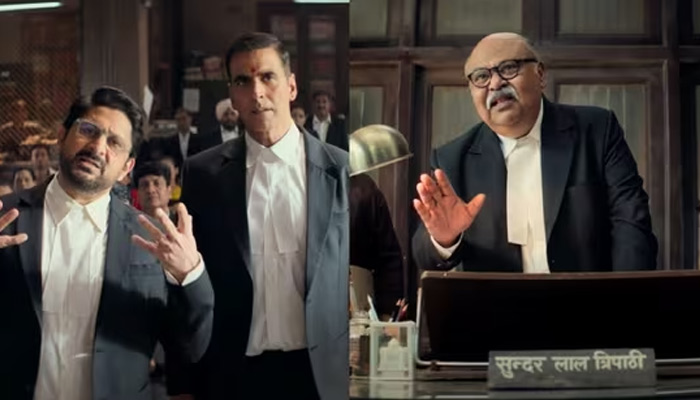
Jolly LLB 3 in the Dock: When Satire Faces a Real Courtroom Battle
Bollywood thrives on courtroom theatrics—think Sunny Deol’s immortal “tareekh pe tareekh” in Damini. The Jolly LLB series tapped into that tradition with biting satire on India’s legal system. But ahead of its September 19 release, Jolly LLB 3 has stumbled into its own legal drama, with the reel court colliding with the real one.
The film, starring Akshay Kumar and Arshad Warsi, has been hit with a series of Public Interest Litigations (PILs). Lawyers and bar associations claim the film insults the judiciary. A Patna lawyer has asked for a ban on its songs and trailer, objecting to judges being referred to with slang like “mama.” The plea seeks edits cleared by the Bar Council of India and even a public apology. In Pune, advocates have moved for a pre-release injunction, and a local court has summoned Kumar, Warsi and director Subhash Kapoor to appear in person on October 28.
It’s not the franchise’s first brush with litigation—the Ajmer District Bar Association tried to halt filming last year. But the uproar raises a bigger question: are PILs, once hailed as a revolutionary tool of justice, being stretched into censorship battles?
The rise of PILs
PILs are uniquely Indian. In the late 1970s and 1980s, Justices P.N. Bhagwati and V.R. Krishna Iyer expanded “locus standi,” allowing anyone to file petitions on behalf of the voiceless. The idea was radical: open the courts to bonded labourers, undertrials, the hungry, and the dispossessed.
Landmark rulings followed:
Hussainara Khatoon (1979) freed thousands of undertrials and cemented the right to a speedy trial.
MC Mehta cases cleaned up the Ganga and toughened pollution laws.
Vishaka (1997) laid down workplace sexual harassment guidelines long before legislation.
In these moments, PILs became a bridge between constitutional ideals and everyday justice.
From tool of justice to tool of spectacle
But with success came overuse. Courts today are flooded with petitions filed for politics, publicity, or personal grievance. The Supreme Court itself has warned against “Publicity Interest Litigation.” Former CJI N.V. Ramana called frivolous PILs “a new form of abuse.”
India’s judiciary is already staggering under the weight of over 50 million pending cases. Every weak petition further clogs the system. Critics also argue PILs have emboldened judges to stray into policymaking—dictating fuel norms, school meals, even policing reform—blurring the line between activism and overreach.
Satire on trial
That tension is embodied in the Jolly LLB 3 controversy. Should courts spend their time debating whether a film trailer demeans lawyers? To many, such PILs trivialise a serious legal instrument. Yet for petitioners, portrayals that make lawyers look like buffoons feel like an attack on their dignity.
The irony is hard to miss. A franchise built on courtroom satire now faces real summons. Kumar and Warsi, who play lawyers onscreen, will have to defend themselves offscreen too. And while audiences await another round of scripted fireworks in Jolly LLB 3, the bigger battle may be whether India’s most innovative judicial tool is being diluted into a mechanism for censorship.
Comments are closed.