

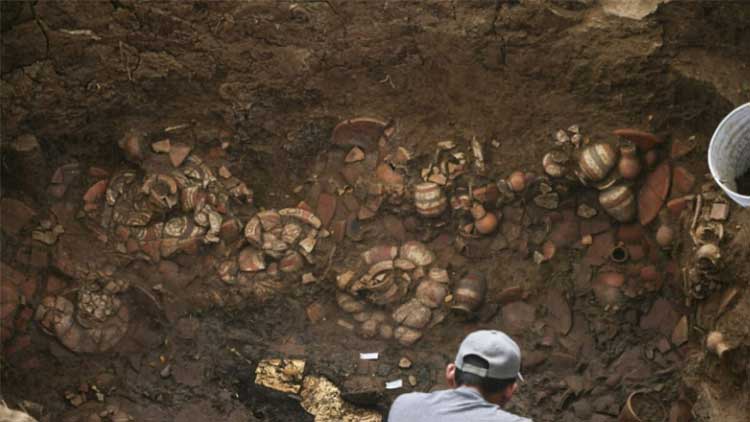
Archaeologists have uncovered a tomb more than a thousand years old in Panama, revealing human remains accompanied by gold ornaments and ceramic artifacts, researchers said.
The find was made at the El Caño archaeological site in the Natá district, roughly 200 kilometers southwest of Panama City. The region has been the focus of extensive excavations for over two decades, during which scientists have documented significant evidence of pre-Hispanic cultures.
According to lead archaeologist Julia Mayo, the skeletal remains were discovered surrounded by gold objects and intricately decorated pottery, indicating the burial of individuals of elevated social standing. The tomb is believed to date from between 800 and 1000 AD.
“The individual associated with the gold items appears to have held the highest social status within the group,” Mayo explained. The remains were found with multiple gold pieces, including bracelets, earrings, and a pectoral ornament featuring animal motifs such as bats and crocodiles.
The El Caño site is linked to societies that inhabited Panama’s central provinces between the 8th and 11th centuries. Researchers believe the location served as an important ceremonial burial ground for approximately two centuries.
Mayo noted that several similar tombs have previously been identified at the site, underscoring the area’s archaeological significance.
Panama’s Ministry of Culture described the discovery as an important contribution to understanding pre-Hispanic societies of the Central American isthmus. Experts say such findings highlight how social hierarchy and status continued to play a role in burial practices, suggesting that death was viewed as a transition rather than an end.
Comments are closed.