
Five major flashpoints — from Iran to AI — likely to shape Donald Trump-Xi Jinping meeting in China

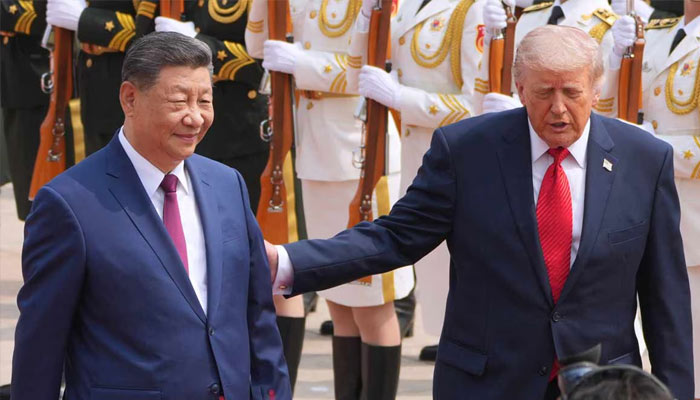
Donald Trump has arrived in China for a major state visit, marking the first trip to the country by a sitting US president in nearly a decade.
The visit comes amid rising geopolitical tensions, continued conflict in the Middle East and deepening rivalry between Washington and Beijing across trade, technology and security. With relations between the two global powers remaining strained, Trump’s talks with Chinese President Xi Jinping are expected to focus on several high-stakes issues. According to a report by The Guardian, five major topics are likely to dominate the summit.
1. US-Iran conflict and the Strait of Hormuz
One of the key issues expected to feature in the discussions is the ongoing US-Iran conflict and the future of the Strait of Hormuz. Trump is reportedly hoping China will use its influence to encourage Iran toward peace talks and support efforts to reopen the crucial shipping route.
Beijing has so far avoided publicly intervening in the conflict, but China has significant economic interests tied to the waterway, with nearly half of its crude oil imports passing through the Strait of Hormuz. Chinese leaders are also concerned that any prolonged disruption to oil supplies could trigger a global recession and hurt Chinese exports.
The issue has become even more sensitive after the US imposed sanctions this week on several Chinese firms accused of helping Iranian oil shipments and allegedly supplying satellite imagery used in Iranian military operations. China has rejected the allegations.
Trump’s visit also comes shortly after Iranian Foreign Minister Abbas Araghchi travelled to Beijing last week.
2. Taiwan tensions remain a major flashpoint
Taiwan is expected to be another central issue during the summit. China is likely to raise concerns over Trump’s recent remarks suggesting he was open to discussing US arms sales to Taiwan — the self-governed island Beijing considers part of its territory.
Last December, Trump approved an $11 billion arms package for Taiwan, reportedly the largest weapons deal ever signed for the island, although the deliveries never took place. Beijing is also expected to pressure Washington to adopt stronger wording against Taiwanese independence, preferring the US to explicitly “oppose” independence rather than simply “not support” it.
The issue has already caused friction in recent weeks. China’s foreign minister reportedly urged US Secretary of State Marco Rubio during a phone call to “make the right choices” on Taiwan.
3. AI rivalry turns into technological cold war
Artificial intelligence has emerged as another major area of competition between the two countries. The US and China are increasingly locked in what many analysts describe as a technological cold war, particularly over AI development and semiconductor access.
In April, Washington accused China of stealing intellectual property from American AI companies on a large scale, an allegation Beijing denied. China has meanwhile criticised restrictions imposed on exports of advanced AI chips produced by Nvidia.
Although the White House earlier announced that Nvidia would be allowed to export its H200 chip to China, shipments have reportedly still not started.
4. Trade war and rare earth tensions
Trade remains one of the biggest sources of tension between Washington and Beijing. Last year, Trump imposed tariffs exceeding 140 percent on Chinese imports, prompting China to respond by restricting exports of rare earth minerals and magnets to the US.
Despite some easing measures, the US still maintains tariffs of around 10 percent on many Chinese products following the 2025 trade war escalation. The issue has gained additional urgency because the US increasingly relies on critical minerals used in defence equipment and advanced technology supply chains dominated by China.
Reports suggest Beijing could announce major purchases involving Boeing aircraft, along with US agriculture and energy products during the visit. In return, China is expected to seek reduced American restrictions on advanced semiconductor exports.
5. Fentanyl dispute remains politically sensitive
The fentanyl crisis is also expected to feature heavily in Trump’s discussions. For years, the US has accused Chinese businesses of supplying chemical ingredients used by Mexican drug cartels to manufacture fentanyl. The issue remains politically significant for Trump, especially among his MAGA support base.
However, China has pushed back strongly against earlier tariff threats linked to fentanyl, weakening Washington’s leverage on the issue. The two countries also clashed over fentanyl and trade during a United Nations narcotics meeting earlier this year.
China is reportedly hoping to be removed from the US State Department’s annual list of “major drug transit or illicit drug producing countries,” which is expected to be updated later this year.
Comments are closed.