

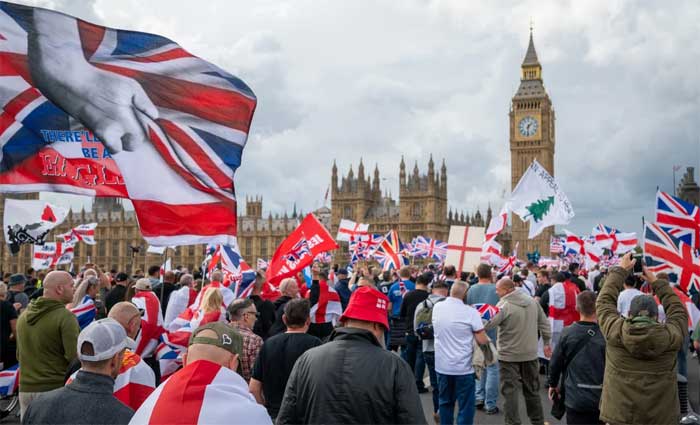
Prime Minister Keir Starmer said 11 foreign far-right extremists have been barred from entering the UK ahead of major protest rallies planned in central London this weekend.
Among those denied entry is US-based far-right figure Valentina Gomez, who British authorities accused of using “inflammatory and dehumanising rhetoric” targeting Muslim communities.
The announcement comes as thousands of demonstrators are expected to gather in London on Saturday for an anti-immigration march organised by Unite the Kingdom, alongside a separate pro-Palestine counter-protest supported by Stand Up to Racism.
In a video message posted on social media, Starmer urged Britons to “fight for the soul of the country,” warning against rising extremism and division.
“Its organisers are peddling hatred and division, plain and simple,” Starmer said. “We will block those coming into the UK who seek to incite hatred and violence.”
He also warned that anyone attempting to intimidate communities or cause disorder on the streets would face “the full force of the law.”
Massive security operation planned across London
The Metropolitan Police described the weekend policing effort as “unprecedented,” with thousands of officers set to be deployed across central London.
Deputy Assistant Commissioner James Harman said the operation has been in planning for months and will involve live facial recognition technology, helicopters, drones, dog units, mounted police, armoured vehicles and specialist investigative teams.
Police said they would take a zero-tolerance approach toward antisemitism, anti-Muslim hate, incitement to violence or expressions interpreted as support for terrorism.
Authorities specifically warned that chants such as “globalise the intifada” could lead to arrests because of what police described as antisemitic connotations.
The far-right rally organised by anti-Islam activist Tommy Robinson is expected to gather at Parliament Square, while the separate Nakba Day pro-Palestine march is scheduled to assemble around a kilometre away at Waterloo Place.
Nakba Day commemorates the displacement of Palestinians during the 1948 Arab-Israeli war and is observed annually in May.
New legal guidance issued over protest slogans and symbols
Ahead of the demonstrations, the Crown Prosecution Service issued updated legal guidance on prosecuting inflammatory placards, chants and banners used during protests.
Director of Public Prosecutions Stephen Parkinson stressed that while peaceful protest and free speech remain fundamental democratic rights, those protections do not extend to hate speech or intimidation.
“This is not about restricting free speech,” Parkinson said. “It is about preventing hate crime and protecting the public, particularly at a time of heightened tensions.”
British authorities now face the challenge of balancing large-scale protest rights with growing security concerns amid heightened political and communal tensions across the country.
Comments are closed.