
Bankipur Bypoll: Prashant Kishor’s Electoral Debut Pits Him Against BJP Bastion, RJD’s M-Y Base

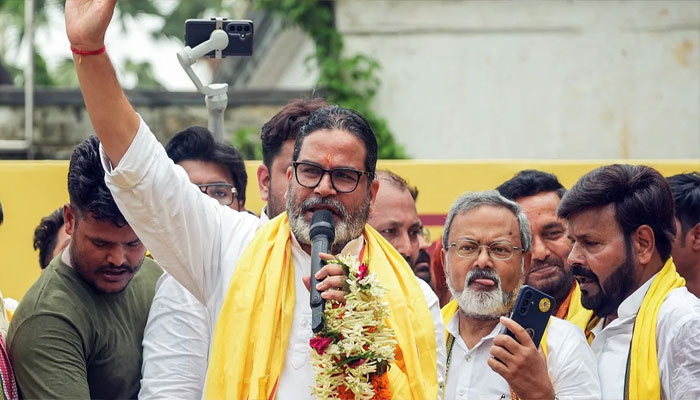
Why the Bankipur bypoll is Prashant Kishor’s biggest political test yet
For years, Prashant Kishor built winning election strategies for some of India’s biggest political parties. On Wednesday, however, the Jan Suraaj founder faces a very different challenge—convincing voters to elect him.
Kishor is making his electoral debut in the Bankipur Assembly bypoll, a contest that has evolved from a routine by-election into one of Bihar’s most politically significant battles. The result will not only determine who represents the Patna constituency but could also offer crucial clues about Jan Suraaj’s future, the BJP’s dominance in urban Bihar, and the Rashtriya Janata Dal’s (RJD) ability to retain its traditional Muslim-Yadav (M-Y) support base.
The seat fell vacant after BJP national president Nitin Nabin resigned following his election to the Rajya Sabha. Nabin had represented Bankipur for nearly two decades, while his family has remained politically influential in the constituency for over 35 years.
Although bypolls are also underway in Gujarat’s Manjalpur and Madhya Pradesh’s Datia, Bankipur has emerged as the most closely watched contest. Votes will be counted on August 3.
- A three-way battle with high stakes
- The bypoll has become a prestige contest for all three major players.
For the BJP, the challenge is to defend one of its safest Assembly seats and reaffirm its organisational dominance in Bihar. For Jan Suraaj, the election is an opportunity to prove that the party can convert Prashant Kishor’s popularity and campaign narrative into electoral success after failing to win a seat in the 2025 Assembly elections.
For the RJD, the contest will indicate whether its long-standing Muslim-Yadav alliance remains intact or whether sections of its traditional support base are drifting towards Jan Suraaj. Political commentator and VoteVibe founder Amitabh Tiwari believes Muslim voters appear to be gravitating towards Kishor’s party.
“The Muslim voters are consolidating behind Prashant Kishor’s Jan Suraaj because it is the party that’s best placed to take on the BJP. However, which way the Yadav votes go will be interesting to see,” he told India Today Digital.
What the numbers suggest
A VoteVibe opinion poll projects the BJP to remain ahead but suggests the contest is far more competitive than in previous elections. The survey estimates the BJP at 44.9% of the vote, Jan Suraaj at 33.8% and the RJD at 17.8%.
Compared with the previous Assembly election, Jan Suraaj’s projected support has risen sharply, while both the BJP and the RJD are expected to see lower vote shares. The findings suggest Kishor has succeeded in making what was once considered a comfortable BJP seat into a genuine contest.
- Why the BJP left nothing to chance
- Despite Bankipur’s reputation as a BJP fortress, the party ran an intensive campaign.
Senior leaders, including Chief Minister Samrat Choudhary, Union ministers Giriraj Singh and Nityanand Rai, MP Ravi Shankar Prasad and Nitin Nabin, campaigned extensively in the constituency. Former Chief Minister Nitish Kumar also appealed to voters through a video message.
The BJP’s campaign featured roadshows, door-to-door outreach and a network of 40 star campaigners, including Manoj Tiwari, Pawan Singh and Maithili Thakur. The party also changed its candidate midway through the campaign, replacing Abhishek Kumar Sinha with BJP youth leader Neeraj Kumar Sinha after controversy over the former’s father’s alleged links to the Bihar fodder scam.
Political observers also linked the Bihar government’s decision to withdraw cases against Gen Z protesters involved in examination paper leak demonstrations to its outreach efforts before the bypoll.
- A critical moment for the RJD
- The bypoll may prove equally significant for the RJD.
For decades, the party has relied on its Muslim-Yadav social coalition. If Muslim voters shift towards Jan Suraaj while Yadav voters remain with the RJD, the anti-BJP vote could split, benefiting the BJP. However, if Jan Suraaj attracts support from both communities, it could reshape Bihar’s opposition politics.
“For the RJD loyalists, it ultimately boils down to whether they want to defeat the BJP or save the RJD,” Tiwari said.
Can Jan Suraaj change Bihar’s political equation?
Bankipur’s demographic profile makes it an ideal testing ground for Kishor’s politics.
The constituency has around 3.69 lakh voters. Kayasths and Yadavs together account for roughly one-fourth of the electorate, while Muslims and Chandravanshis together comprise nearly one-fifth. Several other communities, including Vaishyas, Dalits, Bhumihars, Rajputs, Brahmins, Kurmis and Kushwahas, also have a significant presence.
Unlike Bihar’s traditional parties, Jan Suraaj has sought to focus on governance, education, employment and administrative reforms instead of caste-based mobilisation. The bypoll will test whether that message resonates with voters in a state where caste arithmetic has long shaped electoral outcomes.
- A result with statewide implications
- Even if the BJP retains Bankipur, the bypoll has already altered Bihar’s political narrative.
Prashant Kishor has positioned Jan Suraaj as a challenger not only to the BJP in an urban stronghold but also to the RJD as the principal opposition force.
For the BJP, victory would reinforce its dominance in one of its safest constituencies. For the RJD, the result could reveal whether its traditional support base is beginning to erode. And for Prashant Kishor, the outcome will provide the clearest indication yet of whether Jan Suraaj can emerge as a serious political force ahead of Bihar’s next Assembly election.
Comments are closed.